
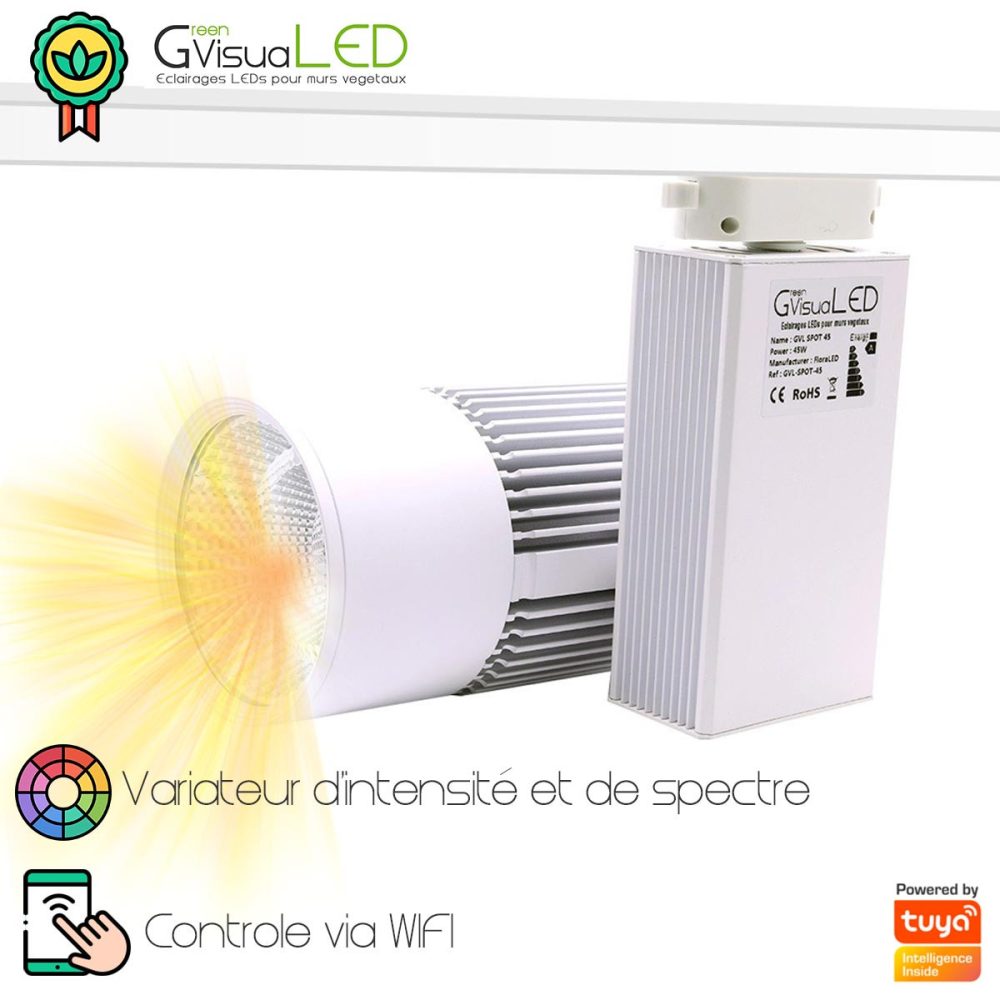
How far should spotlights be from a green wall?
The distance between a light fitting and a green wall should be chosen according to the installation geometry and the equipment. Two spotlights with the same wattage can distribute light very differently. A stated distance is difficult to apply elsewhere unless the light fitting, optic and orientation are specified.
Here is a method for planning your layout and then checking the light received by the plants.
1. Describe the wall and mounting options
Record the wall's width and height. Estimate the foliage depth and note where plants protrude. Measure the available distance between the plane of the leaves and the light fittings, as well as their mounting height.
Identify windows, obstacles and the areas people normally use. A beam should reach the plants without causing excessive discomfort to anyone using the room. Also note how the fittings can be cleaned and redirected.
2. Check the optic before choosing wattage
Electrical wattage does not describe the shape of the beam. A narrower optic may concentrate more light in one area, while a wider optic may spread it over a different surface. The result depends on the equipment and its position.
In a simple geometry, the theoretical diameter of a cone on a plane perpendicular to its axis is 2 × distance × the tangent of the half-angle. This relation describes an ideal geometry. It defines neither a sharp beam edge nor an area sufficiently lit for plants, and it does not apply directly to a wall lit at an angle.
When planning a project, request the available distribution data for the chosen model and optic. Check the distance and conditions under which the data were obtained.
3. Check several points at leaf level
A single reading at the centre of the wall may hide a darker lower area or an over-lit section. Create a grid of measurement points at the top, middle and bottom, and on the left, centre and right. Add points around protruding or shaded areas.
Measure on the plane you want to assess. To compare a vertical surface, keep the sensor orientation consistent and document it. A horizontal reading at floor level does not directly represent the light received on that vertical plane.
For each set of readings, note the sensor model and orientation, which fittings are on, their settings and the natural-light conditions. Lux and PPFD values are not interchangeable; their relationship depends in part on the light spectrum.
4. Review the distribution before changing the setup
Compare the readings with the targets chosen for the plant species. If the top of the wall is very bright and the bottom is too dim, increasing the overall output may make the imbalance worse. Check the orientation, distance, optic or number of light points instead.
If an area remains dim behind a large leaf, the problem may be caused by the shape of the foliage. A more powerful fitting is not necessarily the answer. Consider the layout and foliage maintenance together.
After each change, take readings again at the same points. Comparing them makes it easier to understand the effect of the adjustment.
5. Combine distance with scheduling
A light reading at a single moment does not describe the whole day. Record how long the lights are on and the contribution from natural light. This information helps you assess daily exposure against plant needs.
Extending the lighting period does not automatically correct uneven distribution. Similarly, a setting that works in summer may need to be reviewed in winter.
When should you request a lighting layout study?
A study is particularly useful for a tall wall, limited clearance, a restrictive ceiling or a project where glare must be controlled. Prepare a dimensioned plan, photographs and a list of the plants you are considering.
Explore the lighting solutions for green walls, then send us your project requirements. Track-mounted spotlights are among the options to consider, depending on the available mounting points.
Planning a professional project? See the specification checklist for an office green wall and its preparation grid.
Related posts
 Discreet Green Wall Lighting: LED Design Guide
 Recessed Directional Grow Spot: A Guide for Plants and Green Walls
 Recessed LED Grow Bars for Green Walls: 2026 Comparison Guide