
Artificial light for houseplants: LED grow-light guide
Artificial lighting is changing how we grow houseplants by giving us precise control over their light conditions.
When natural sunlight is lacking, a well-designed horticultural LED light provides the full spectrum needed for photosynthesis while using less energy.
How artificial light can replace sunlight for houseplants
The latest horticultural LED innovations make it possible to adjust light intensity precisely for different plants, whatever the season.
These solutions faithfully reproduce the solar spectrum, supporting healthy growth without relying on natural light.
Why full-spectrum LEDs closely imitate natural light
LED plant lights cover the ideal spectral range (400–700 nm) in which photosynthesis takes place.
Our GVL SPOT 200W combines red, blue and green wavelengths to support every stage of plant development, from growth to flowering.
- Balanced red-blue-green spectrum : ideal for chlorophyll production, vigorous growth and flowering.
- High light efficacy : more than 150 µmol·s⁻¹·W⁻¹ for high-performance, energy-efficient horticultural lighting.
- No harmful radiation : no UV or infrared to protect your plants and visual comfort.
- Natural colour rendering : brings out the true colours of your houseplants.
Discover our GVL SPOT 200 horticultural LED light, which supports plant growth with an optimised full spectrum and outstanding light output.
Alternating between warm and neutral white every two weeks can particularly benefit orchids during flowering.
What light intensity do different houseplants need?
A lamp's ability to replace sunlight depends mainly on its light intensity, measured in lux or µmol·m⁻²·s⁻¹.
Depending on the species, plants need between 2,000 and 10,000 lux—levels readily achievable with a good horticultural LED light.
| Plant type | Recommended intensity | GreenVisuaLED solution | Installation distance |
| Foliage plants (ferns, pothos) | 2,000–4,000 lux | 5W GU10 bulb | 20–30 cm |
| Bonsai and succulents | 4,000–6,000 lux | 7W GU10 bulb | 30–40 cm |
| Orchids and flowering plants | 6,000–8,000 lux | GVL SPOT 200W | 40–50 cm |
| Professional green walls | 8,000–10,000 lux | Two GVL SPOT 200W lights | 40–60 cm |
How many hours of light do plants need?
For healthy growth, schedule 12 to 16 hours of artificial light each day, followed by 8 hours of darkness.
During flowering, reduce this to 10–12 hours to respect the plants' natural cycle.
In spaces with less than 500 lux of ambient light, extend the lighting period to up to 18 hours.
This allows even a windowless room to support a lush green wall with an effective horticultural light.
Which type of LED light should you choose for healthy growth?
LED grow lights are now the preferred way to light houseplants. Their main advantage? An adaptable full spectrum and excellent energy efficiency. Good lighting depends on choosing a bulb whose intensity and light spectrum match your plants' needs throughout their growth cycle.
Why horticultural LEDs outperform other lighting technologies
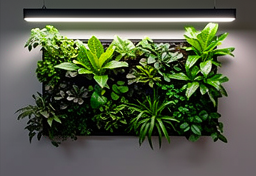
If you're wondering which type of light helps plants grow, horticultural LEDs offer excellent value: low energy use, long life and the ability to fine-tune the spectrum. Compared with older fluorescent lights, these bulbs use up to 70% less energy and last much longer (30,000 to 50,000 hours).
Another major advantage is their very low heat output, which allows them to be placed close to foliage without scorching plants. As a result, your plants receive all the light intensity they need. This is a welcome alternative to HPS systems, which often require costly ventilation.
- Guaranteed savings : efficacy above 150 µmol·s⁻¹·W⁻¹ helps lower electricity bills.
- Exceptional lifespan : over 50,000 hours of use with only 30% loss of brightness.
- Customisable spectrum : adjust blue and red wavelengths to suit growth or flowering.
- Easy installation : compact formats suit many types of support, including spotlights and tracks.
Our ideal GU10 LED bulb for houseplants combines a compact size with an optimised spectrum, making it perfect for bonsai and plant displays with excellent efficiency. Although fluorescent lights remain an economical option for small areas, they cannot match modern LED performance.
Blue vs. red spectrum: adapting light to each growth stage
A good grow light should offer different settings for each stage of plant development. Blue light (440–460 nm) encourages dense vegetative growth, while red light (630–660 nm) supports flowering and fruiting.
For ornamental foliage plants, maintain a balanced blue-to-red ratio (1:1). For flowering or fruiting species, choose a 1:3 or 1:4 ratio favouring red to encourage bud formation.
GU10 bulb or 200W spotlight: what output do your plants need?
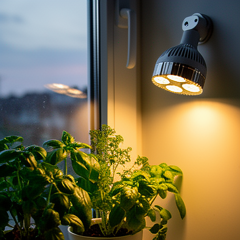
The output you need depends directly on the area to light and the distance between the source and the plant. A small 5W LED GU10 bulb is ideal for plants 10 to 30 cm away, such as bonsai. For greater distances, choose the 7W model.
For larger installations, the GVL 200W spotlight covers up to 0.5 m² with its balanced full spectrum. Allow at least 20 watts in total for a growing area, adding more light sources as needed to ensure even distribution and healthy growth.
Installation and settings to get the most from your LED lighting
To optimise your horticultural LED lighting, consider three key factors: the ideal distance between the grow light and your plants, accurate timer settings and close observation of how the plants respond. Mastering these settings extends equipment life, maximises light intensity and supports photosynthesis in your indoor garden.
Distance and output: adjusting intensity for plant size
Light intensity falls quickly as the source gets farther away. For effective plant lighting, position your lamp:
- 20–30 cm from delicate seedlings—the moderate intensity encourages rooting without heat stress.
- 30–45 cm during active growth—the GVL SPOT 200 then covers a broad area evenly.
- 45–60 cm for mature plants—this distance removes dark spots while protecting the foliage.
At 40 cm, the GVL SPOT 200 ideally lights a 70 × 70 cm area, perfect for green walls and decorative planters. A simple aluminium reflector can increase brightness by around 10% without using extra power, a practical option for small spaces.
Timers and light cycles for steady, automated growth
A precise timer maintains stable light cycles, which are essential to plant circadian rhythms and photosynthesis. Irregular artificial lighting can disrupt these processes and reduce growth and flowering.
- Vegetative phase : schedule 12–16 hours of blue and red light to support foliage development.
- Flowering period : gradually reduce LED lighting to 10–12 hours, followed by 12 hours of complete darkness.
- Consistency : keep a fixed schedule to avoid light stress.
- Light-demanding plants : extend artificial lighting to up to 18 hours in low-light environments.
Adjustable supports (30–160 cm) suit each growth stage. Group plants according to their lux and spectrum needs to improve your setup's energy efficiency.
Detecting and correcting too much or too little light
Plants quickly show when they need more or less light. Regular observation helps you adjust the LED lighting and maintain ideal conditions for growth and flowering.
- Leggy growth and pale leaves : move the light closer or extend the exposure time.
- Slow growth : increase LED intensity or lengthen the photoperiod.
- Scorched leaves : move the grow light farther away immediately.
- Chlorosis : check the spectrum balance, especially the blue component.
Clean leaves regularly—dust can block up to 20% of the light. Turning plants weekly ensures even exposure to the grow light.
Discover our 30W horticultural LED light for plants, with a balanced spectrum and easy installation for green walls and indoor gardens. For comparison, a living room receives around 500 lux, compared with over 15,000 lux in full sun—showing why effective LED lighting matters for indoor growing.
Frequently asked questions
Can an LED light really replace sunlight completely for houseplants?
Absolutely! A full-spectrum horticultural LED reproduces all the wavelengths required for photosynthesis (400–700 nm). It provides the right light intensity for your plants to thrive, even indoors without access to natural light. Whether for growth or flowering, this artificial light is highly effective.
What output should I choose for a one-square-metre green wall?
For an area of one square metre, we recommend two 200W GVL spotlights, positioned around 40 cm from your plants. This setup provides even light intensity across all your plants. At 12 hours of use per day, monthly consumption is around 57 kWh. It is nearly 30% more economical than traditional HPS lights while providing excellent coverage with horticultural LED technology.
How can I tell whether my plants get too much or too little artificial light?
Look for several clear signs: if your plants have very elongated stems, discoloured leaves and slow growth , their light intensity is insufficient. Move the grow light slightly closer or increase its output. Conversely, curled leaves, scorched edges or brown spots indicate too much light . Move the source farther away or reduce the exposure time to this artificial light. Horticultural LEDs allow precise adjustment to find the right balance.
Related posts
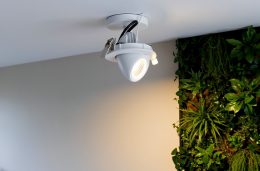 Discreet Green Wall Lighting: LED Design Guide
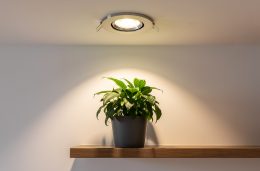 Recessed Directional Grow Spot: A Guide for Plants and Green Walls
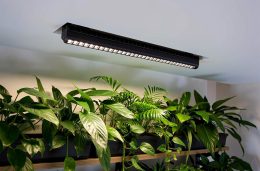 Recessed LED Grow Bars for Green Walls: 2026 Comparison Guide