
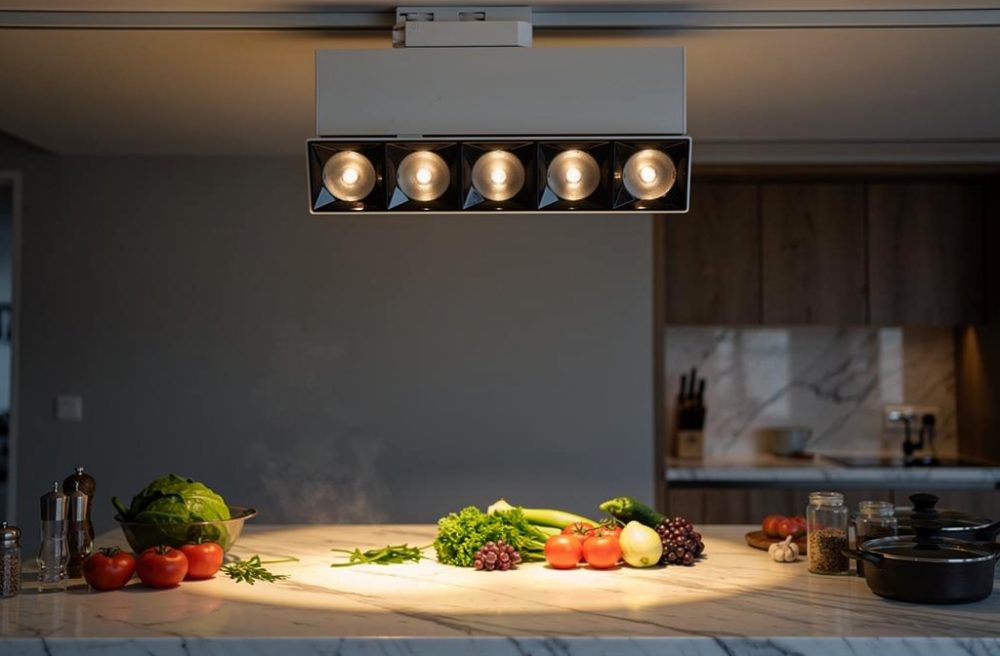
How Many Lumens per m² Does Your Kitchen Need?
This article will help you choose the ideal number of lumens per square metre for your kitchen. We explain how to size your installation by calculating the light output you need, adapting it to your space and following best practices for lighting that is both practical and pleasant.
How many lumens per m² does a kitchen need?
The lighting is fundamental to every modern kitchen, playing a key role in comfort and usability. Knowing how many lumens per square metre you need is essential for designing a lighting system that suits your activities and the layout of the room.
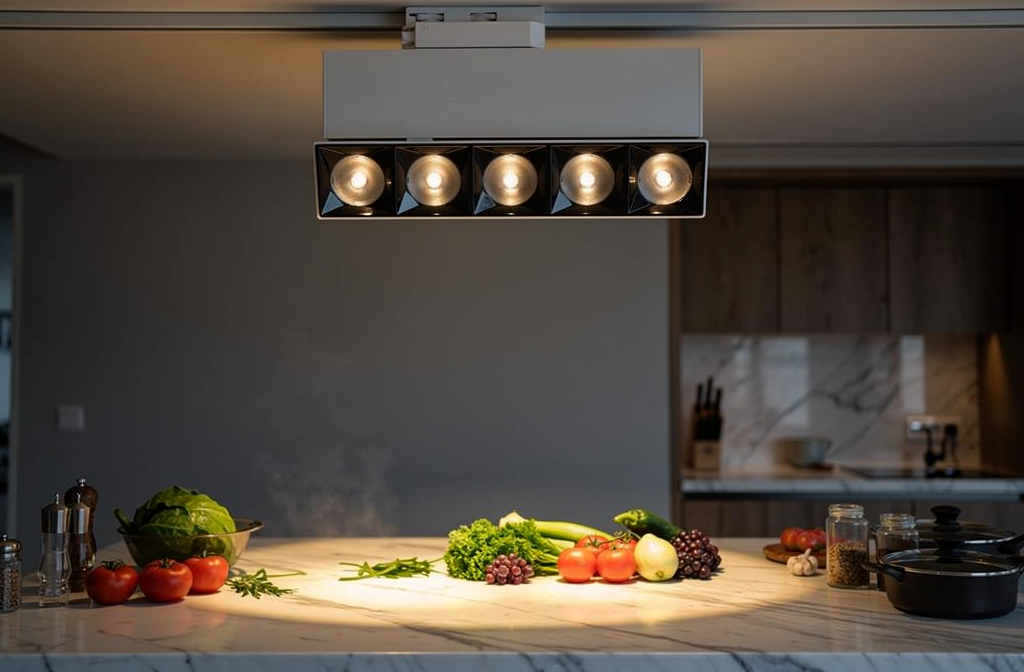
Recommended lux and lumens for general lighting
For good kitchen general lighting , aim for an illuminance of 300–500 lux. This equates to a light output of 300–500 lumens per square metre. For example, a standard 10 m² kitchen needs a total light output of 3,000–5,000 lumens. This creates a welcoming atmosphere and provides good visibility for everyday activities.
- Standard range : 300–500 lux provides comfortable vision for daily tasks without causing eye strain.
- Adjusting for high ceilings : if the ceiling is over 3 metres high, increase the light output by 10–20% to compensate for the greater distance.
- Effect of dark surfaces : dark walls and floors absorb light, so add 10–20% more lumens to ensure even brightness.
It is better to spread the light across several light fittings than to rely on a single central source, which can leave shadows. Dimmable LED bulbs also let you adjust brightness to suit natural light and the atmosphere you want.
Calculating the lumens you need for your room
To calculate the lumens you need , use a simple formula: multiply the recommended lux level by the area of your room in square metres. For example, a 12 m² kitchen at 400 lux needs 4,800 lumens (12 m² × 400 lux). This is often rounded up to 5,000 lumens for extra comfort.
It is useful to calculate general lighting separately from the lighting over worktops, where a higher light intensity is needed. Then divide the total lumens by the output of each light fitting to work out how many to install.
LED lighting for worktops and task areas
Once you have planned the general lighting, consider the areas used for food preparation. For comfort and safety, the sink, hob and chopping area need brighter light. This type of lighting requires a different approach from the ambient light used throughout the kitchen.
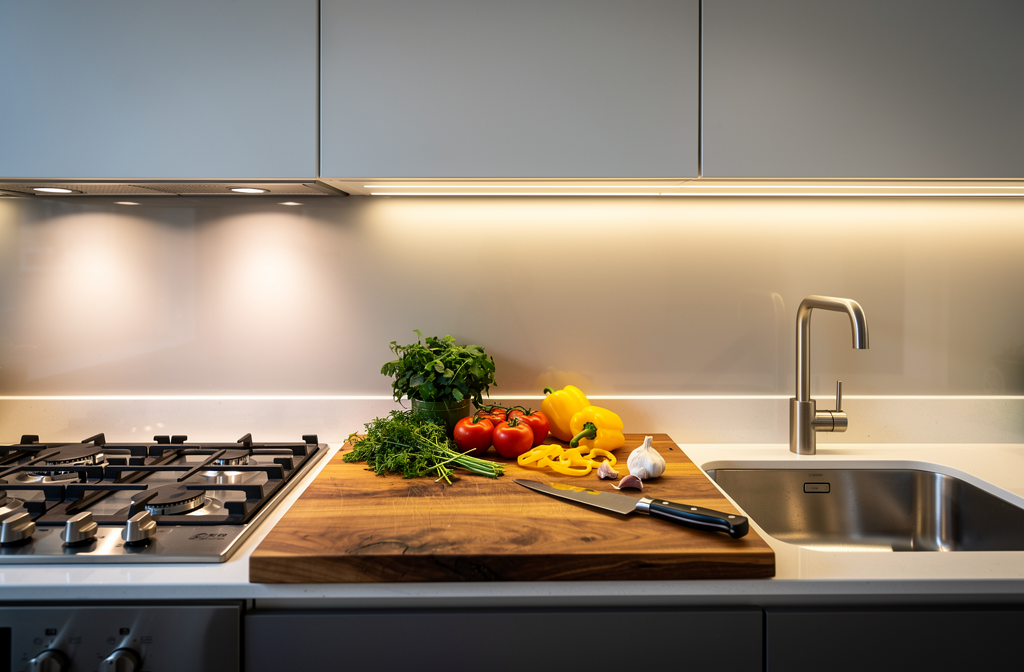
Lumens needed for food-preparation areas
Effective worktop lighting should provide 300–500 lux. This is about 500 lumens per square metre, offering good visibility for chopping and mixing ingredients. Suitable light helps prevent accidents and reduces eye strain during detailed tasks.
- LED strips under cabinets : provide a light output of 200–500 lumens per linear metre, ideal for lighting the worktop without glare.
- Individual spotlights : each spotlight should provide 560–630 lumens for sufficient coverage over the main work areas.
- Sink : it is recommended to provide 500–700 lumens directed at the sink to make cleaning easier and reduce unwanted shadows.
- Cooker : allow 700–900 lumens above the hob so you can monitor cooking safely with good visibility.
If you need to calculate the lighting for a 1.2 square metre cooking area, aim for 720–960 lumens. A light fitting with a narrow beam (30–45°) is ideal for directing the task light exactly where it is needed without wasting light.
| Area | Recommended lux | Lumens needed | Light fitting type |
| General worktop | 300–500 | 500 lumens/m² | LED strips, recessed spotlights |
| Sink | 300–500 | 500–700 lumens | Directional spotlight, LED strip |
| Cooker | 300–500 | 700–900 lumens | Powerful spotlight, LED bar |
| Under cabinets | 200–400 | 200–500 lumens per linear metre | Discreet LED strip |
Choosing an LED colour temperature for each area
Colour temperature has a significant effect on the atmosphere and appearance of your room. For functional LED lighting , choose cool white (4000–6500 K) above the worktop. This task lighting improves visibility and helps you distinguish food colours while preparing meals.
Using different colour temperatures helps define separate areas: a safe, practical workspace and a warmer place to relax. Dimmable fittings are ideal for adjusting the atmosphere to suit your needs. You can switch from task lighting to a welcoming mood in an instant.
- Work areas : choose 4000–6500 K (neutral to cool white) for clear, precise vision.
- General lighting : 3000–4000 K gives comfortable brightness without making the room feel too cold.
- Dining area : choose 2700–3000 K (warm white) to create a relaxed atmosphere for family meals.
- Intensive task lighting : 5000 K is often chosen for busy kitchens where precision matters.
A balanced layout allocates around 50% of the total output to the central ceiling light for general lighting. Then use 30% for functional LEDs under the cabinets and reserve the remaining 20% to add depth.
Balancing general and task lighting
Choosing the right type of lighting means prioritising your light sources. Allocate half the output to the main lighting, using recessed panels for an even base layer, then use 30% for spotlights and bars to support detailed tasks.
The remaining 20% can provide decorative touches with pendant or accent lights, without compromising functionality. This creates a complete, versatile lighting system and lets you adapt your kitchen lighting to different times of day.
Adjustment factors and kitchen lighting installation
Basic calculations may not be enough: architectural features and materials can affect how much light is actually available in your kitchen. Understanding these adjustment factors helps optimise the light output while maintaining adequate lighting and energy efficiency.
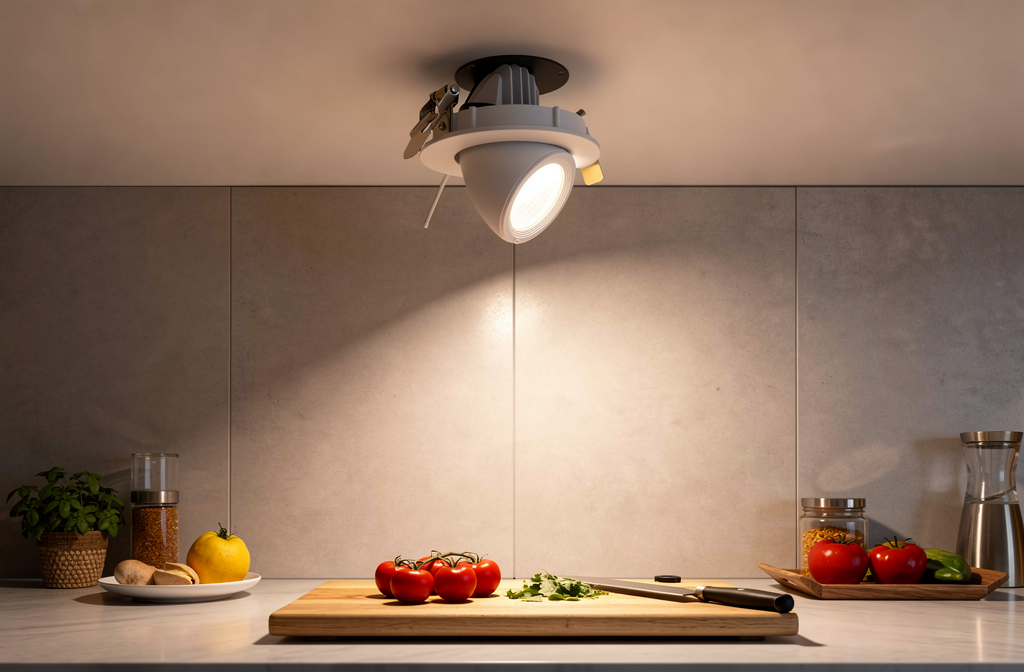
How colours and surfaces affect lumen requirements
Installing light fittings in the kitchen requires careful consideration of materials, because each surface affects how light is reflected. For example, white walls reflect up to 80% of the light, which can reduce the required lumens by 10–20% while maintaining the recommended lux level.
- Light-coloured surfaces : white and cream tones reduce the required lumens by 10–20% and improve ambient lighting.
- Dark surfaces : dark shades such as charcoal grey or black absorb 40–60% of the light, so you may need to increase the light output by 20–30%.
- Glossy white ceiling : reflects light downwards effectively and reduces shadows over the worktop.
- Dark ceiling : scatters light and may require additional spotlights or a more powerful ceiling light to provide enough light.
High-performance reflective surfaces, such as brushed aluminium or specialist diffusers, redirect light effectively. A kitchen with medium-grey walls may need around 15% more lumens than the same room with white walls.
Natural light from large windows partly offsets the need for artificial lighting, reducing the number of lumens required during the day by around 15%. However, a well-designed lighting system is still essential to maintain the right lux level after dark.
Best practices for installing LED light fittings
A careful installation of your light fittings improves the efficiency of your lighting system and extends the life of your LEDs. For even light distribution, space spotlights or ceiling lights around 60 cm apart to avoid dark areas and overly bright spots.
- Even spacing : leave around 60 cm between each light fitting for even general lighting without dark areas or excessive brightness in the centre.
- Small kitchens : choose flat LED wall lights or recessed spotlights to keep the visual space clear and make the room feel larger.
- Installation angles : aim task spotlights at a 30–45° angle and ambient ceiling lights at 120–150° for better visual comfort.
Grouping light sources on a single dimmer makes it easy to adjust the lighting for cooking, dining or cleaning. This flexibility ensures you have enough light for every activity while meeting recommended lux levels.
Frequently asked questions
How many lumens per square metre does a kitchen need?
For comfortable general lighting in a kitchen, it is usually recommended to allow 300–500 lumens per square metre. This is a standard illuminance level measured in lux and suited to living spaces.
Worktops require brighter light for detailed tasks, often around 500 lumens/m² or more, as in a professional kitchen. To calculate the number of lumens you need, multiply your room area by the recommended average of 400 lux .
To light a 12 m² kitchen properly, aim for a total of 4,800–6,000 lumens. This provides enough light to cook safely while maintaining a welcoming atmosphere.
How many total lumens are needed to light a kitchen?
The number of lumens you need to light a kitchen depends largely on its size and features. A standard 10 m² kitchen, for example, needs around 3,000–5,000 lumens for general lighting.
Then add 500–1,000 lumens for worktop lighting, depending on the area. If the kitchen is 15 m² and has a high ceiling or dark walls, increase the total to around 6,500–7,500 lumens.
This calculation includes both ambient and task lighting, allowing for light absorption by surfaces. A lighting professional can help refine the figures for your specific layout.
How can I optimise kitchen lighting with LEDs without using too much energy?
To optimise your kitchen lighting without wasting energy, choose high-efficiency LED bulbs producing more than 100 lumens per watt. A dimmer makes it easy to adjust light output to the time of day and the activity.
Use light-coloured, reflective surfaces to make the most of natural and artificial light without increasing energy consumption. Several moderate-output light fittings are often more effective than one very bright source.
Finally, colour temperature matters for visual comfort. Neutral light between 4000 and 5000 K is ideal for tasks, while a warmer tone around 3000 K suits the overall atmosphere.
Related posts
 Discreet Green Wall Lighting: LED Design Guide
 Recessed Directional Grow Spot: A Guide for Plants and Green Walls
 Recessed LED Grow Bars for Green Walls: 2026 Comparison Guide