
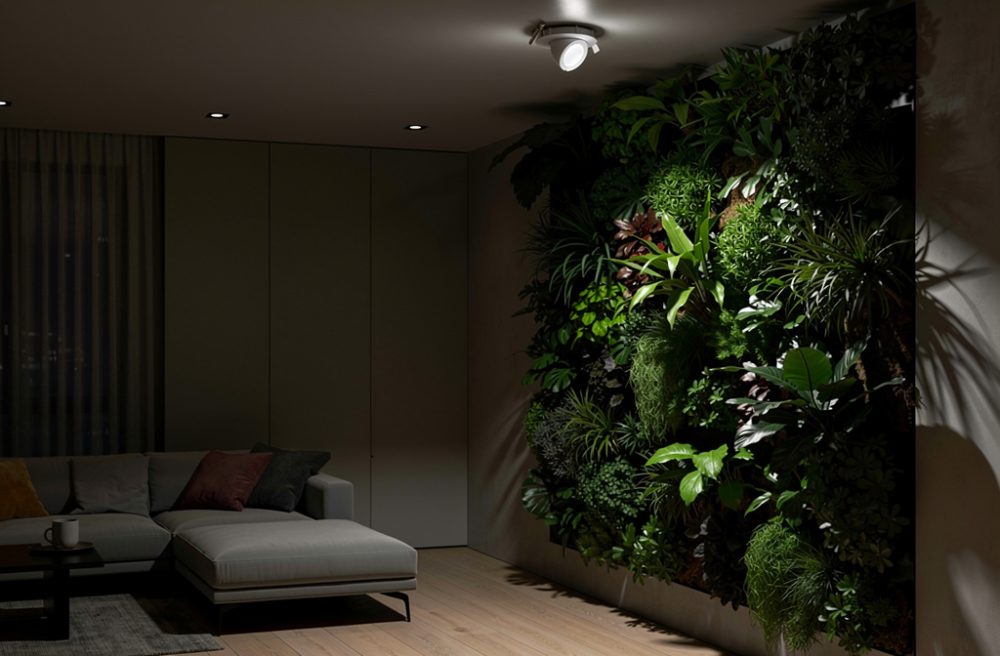
Recessed Lighting for Green Walls: 12 W to 50 W LED Spotlights
This article will help you choose a recessed light for your green wall. It addresses the need for LED solutions that are efficient, compact and attractive. You will learn how to choose the power best suited to your installation, how to position your recessed LED spotlights to achieve a light intensity that is perfectly even, and how to integrate them into your interior design to support optimal plant growth.
How to choose recessed spotlights for green walls
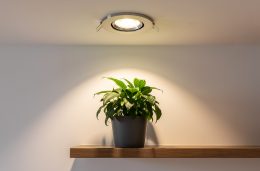
The recessed LED spotlights are an ideal way to light plant pictures and green walls discreetly and effectively. Recessed into the ceiling, they stay out of sight while providing professional horticultural lighting designed specifically to meet the photosynthetic needs of your green wall.
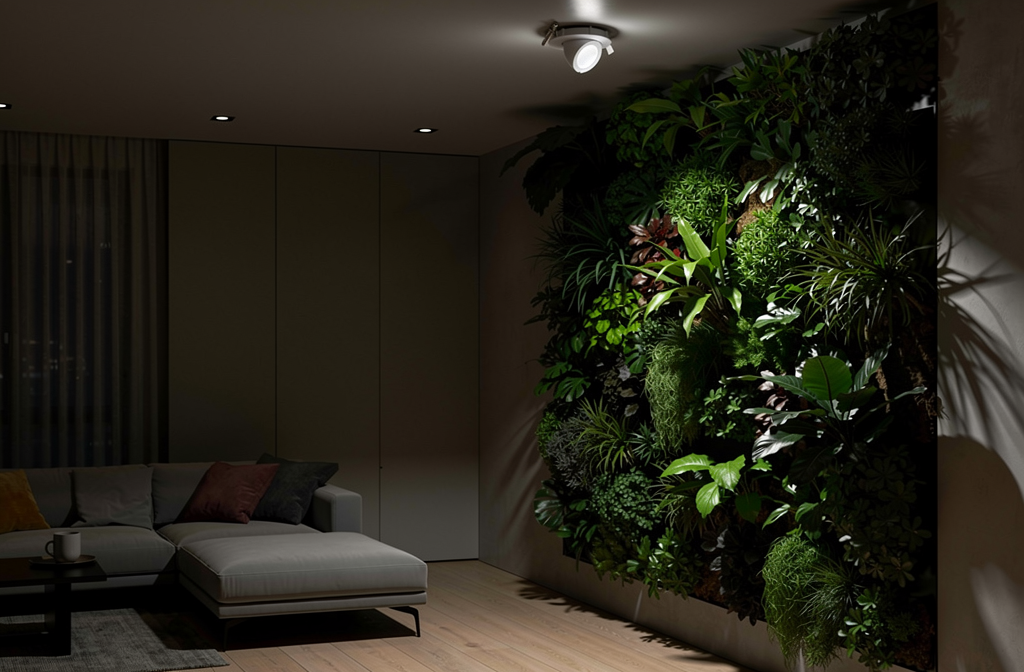
What horticultural LED power do you need for your green wall?
Choosing the power is essential: it determines the light coverage and energy efficiency of your installation. The recessed spotlights are available in 12 W, 35 W and 50 W, allowing them to suit a range of layouts, from a small plant picture to a large professional green wall requiring intensity that is even and sustained.
- 12 W spotlights for small areas : Ideal for spaces up to 1 m², these recessed spotlights provide an economical horticultural LED light that is ideal for offices or decorative niches.
- 35 W spotlights for medium-sized walls : Suitable for walls about one metre high, they offer an excellent balance between light output and moderate energy consumption.
- 50 W spotlights for large areas : Essential for structures over 1.5 m high, they provide high intensity even when the lights are spaced farther apart.
A 12 W model equipped with CREE LEDs can easily replace a 75 W incandescent bulb and produces more useful light. For a 1 m² green wall, two recessed spotlights placed diagonally create even illumination and can increase foliage density by around 15% compared with simple accent lighting.
Optimal distance and positioning for recessed spotlights
The distance between the light source and the foliage directly affects how much light the plants receive and helps prevent shaded areas. For green walls, a distance of 30 to 50 cm between the horticultural light and the top of the plants provides even coverage, especially since the LED spectrum produces very little infrared heat.
A horizontal spacing of 25 to 40 cm between spotlights provides even lighting without visible pools of light. For example, six spotlights angled at 30° effectively cover a green wall 3 m wide and support balanced growth for orchids, bonsai or carnivorous plants.
Recessed installation: required dimensions and cut-outs
Successful installation requires precise cut-outs matched to the chosen horticultural light. Models rated at 12 W generally require a circular opening of about 60 to 100 mm. The 35 W versions need a diameter of 145 to 155 mm, while powerful recessed LED spotlights rated at 50 W require an opening of 175 to 190 mm for proper installation.
The standard recess depth is about 60 mm, making these lights compatible with most suspended ceilings. Their 360° adjustable heads let you direct light exactly where it is needed, reducing the need for additional fixtures. The recessed spotlight for green walls uses CREE technology to deliver light evenly across 360°, highlighting plant pictures and green walls while preserving a clean, discreet appearance.
Spectrum and performance of recessed horticultural bulbs
The quality of the horticultural spectrum is key to photosynthesis and to the appearance of foliage in any room. Modern horticultural bulbs combine power, design and energy efficiency. They support vigorous plant growth while providing pleasant light in both homes and professional spaces.
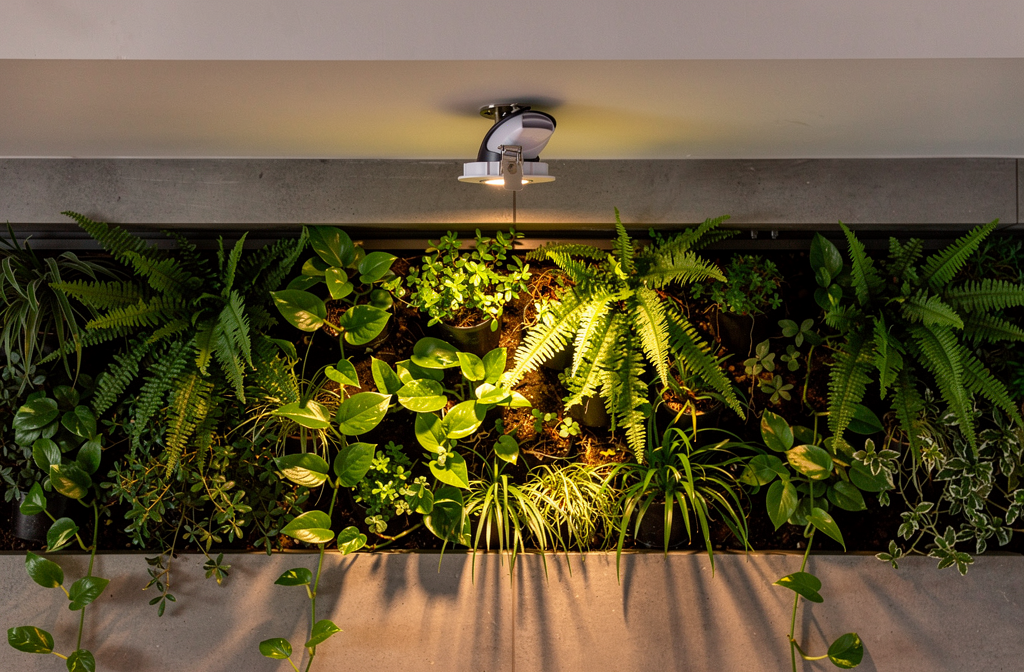
Which light spectrum optimises photosynthesis?
An ideal light spectrum combines blue (400–480 nm) for compact growth and red (620–680 nm) for strong roots and abundant flowering. Each horticultural LED light therefore emits a balanced white light with a colour temperature of 5000 to 6500 K, which mimics daylight and makes it easier to light a range of indoor plants.
A colour rendering index (CRI) above 80 provides a faithful view of plant colours, which is essential for quickly assessing plant health. CREE LEDs produce very little infrared radiation, so they can be placed close to plants (30–45 cm) without risk of scorching. This is particularly useful for green walls and shallow vertical installations.
| Colour temperature | Preferred spectrum | Horticultural use | Visual appearance |
| 3000–3500 K (warm white) | Red-rich | Flowering supplement, ambient comfort | Warm, natural atmosphere |
| 5000–6500 K (neutral/cool white) | Balanced blue and red | Balanced growth, shade-loving plants | Natural daylight |
| Custom full spectrum | Adjustable from blue to red | Adaptable to growth and flowering stages | Appearance adjustable to suit the setting |
Light intensity matched to power, from 12 W to 50 W
The intensity and light output vary with power: a horticultural LED bulb rated at 12 W produces 1,200 to 1,500 lumens, covering about one square metre. A 50 W horticultural LED light can produce 4,500 to 6,000 lumens, lighting up to three square metres depending on its beam angle.
- Higher energy efficiency : a 30 W horticultural LED light can save 70% to 85% of electricity compared with an equivalent halogen lamp, significantly reducing the monthly bill in a room with several spotlights.
- Adjustable light output : a photon flux of 180 µmol·m⁻²·s⁻¹ suits shade-loving plants, while 600 µmol·m⁻²·s⁻¹ benefits species that need higher intensity light levels.
- Smooth dimming : the ability to adjust theintensity from 0 to 100% makes it possible toadapt the amount of light to different growth stages and avoid unnecessary energy use.
- Even coverage : 360° light distribution eliminates hot spots and supports even growth throughout the foliage.
A 50 W horticultural LED light provides consistent intensity, ideal for green walls in professional settings. It can replace several halogen floodlights while maintaining high energy efficiency. For example, three 35 W spotlights scheduled for 14 hours a day increased pothos and philodendron foliage density by 20% in just six weeks.
CREE horticultural-spectrum LEDs can support successful growing without natural light, turning an enclosed space into a garden. Every watt provides intensity suited to plants' photosynthetic needs, with no wasted energy.
%products%
Smart control and energy savings with 30 W and 50 W spotlights
Modern lighting systems include advanced controls that optimiseenergy efficiency while adapting light to plants' natural cycles. This smart control turns a basic installation into a complete lighting system that supports plant growth while significantly reducing electricity consumption.
Power consumption and durability of horticultural lights
thanks to its impressive LED lifespan, which can reach 30,000 to 50,000 hours, depending on the power selected. Used 14 hours a day, it can provide five to ten years of continuous lighting, compared with just one to two years for halogen lamps, leading to substantial maintenance savings.
- Energy savings of 70% to 85% : a correctly designed green wall needs about 35 W per square metre, compared with 200 to 400 W for a halogen equivalent.
- High-efficiency drivers : more than 90% of electrical energy is converted into useful light, limiting heat loss and the need for air conditioning.
- Passive heat dissipation : a recycled-aluminium housing keeps the LED chip below 40°C without a fan, ensuring quiet, reliable operation.
- No infrared radiation : the foliage is protected from scorching, allowing close installation even on green walls in narrow spaces.
A 12 W recessed LED spotlight using CREE technology is an effective replacement for a 75 W incandescent bulb while delivering light that is better suited to photosynthesis. LED technology produces the required spectrum directly, making every photon count for optimal plant growth and greater energy efficiency.
Control features for controllable recessed spotlights
Smart control through a mobile app, dimmer or DMX interface lets you set precise schedules with dimming that smoothly adjustsintensity, recreating the natural alternation of day and night. Energy efficiency is further improved by intensity that can be adjusted: dimming from 0 to 100% delivers the right amount of light for the growth stage, season or room occupancy, avoiding waste from overlighting.
- 12 h/12 h or 16 h/8 h cycles : simulated sunrise and sunset can stimulate plant metabolism and improve visual comfort.
- Colour temperature from 2700 to 6500 K : switch from white warm to white cool via DMX or Wi-Fi to suit each stage of growth.
- Voice control and smart-home integration : compatible with Alexa, Google Home and home automation systems for hands-free control.
An ambient-light sensor automatically adjusts LED output to available natural light, reducing energy use by up to 50% on sunny days. Zone control lights only the areas in use, making every joule count for visible horticultural results on green walls.
Maintenance and warranty for our professional solutions
An exceptional LED lifespan of 30,000 to 50,000 hours greatly reduces maintenance, making the initial investment worthwhile by avoiding frequent replacements. Used 14 hours a day, a recessed LED spotlight can operate for five to ten years, providing remarkable reliability and service savings.
Our range is covered by a minimum three-year manufacturer’s warranty, including replacement if a product fails prematurely. Maintenance is limited to occasional cleaning of the optical surfaces and leaving five centimetres of clearance around the housing for heat dissipation.
Standard IP65 connectors simplify wiring and replacement without specialist tools. Installing several spotlights at moderate power levels, such as 30 W or 50 W, increases redundancy: if one fails, only a small area is affected. The recessed LED spotlight 50 W remains a robust solution for dense green walls, while the 30 W version offers optimal energy efficiency for smaller areas.
Frequently asked questions
What is the ideal distance between a horticultural light and the plants?
For optimal lighting, keep your horticultural light 30 to 50 cm from the foliage. This provides enough light while avoiding the risk of scorching. 12 W models can be placed 25 cm away, while a recessed LED spotlight rated at 50 W should be about 45 cm away to prevent hot spots. Monitor the plants during the first few weeks: yellowing leaves can indicate too much light, while slow growth may mean the distance is unsuitable.
How can you light a green wall evenly and attractively?
To light a green wall evenly and attractively, first calculate how many spotlights you need. Allow about 1 m² of coverage per 12 W spotlight. A 3 m by 1.5 m panel will therefore need five or six strategically placed fixtures.
Space each light source fixture 40 to 50 cm apart and angle it between 30° and 45° for even illumination. Choose a neutral white colour temperature (5000–6500 K) to bring out the foliage naturally. For precise control, choose a model with dimming so you can adjust the intensity as the plants grow.
Which horticultural light should you choose for common houseplants and demanding orchids?
For common houseplants such as pothos or monstera, a neutral white spectrum (5000–6500 K) and moderate power of 9 to 12 W are well suited.
Orchids and other more demanding tropical species need greater power, between 35 and 50 W, and an adjustable light spectrum: more blue during growth and more red to encourage flowering. The recessed LED spotlight in our range offers a flexible solution tailored to your need for a horticultural light.
For larger planted areas, see our complete guide to green wall lighting.
Related posts
 Discreet Green Wall Lighting: LED Design Guide
 Recessed Directional Grow Spot: A Guide for Plants and Green Walls
 Recessed LED Grow Bars for Green Walls: 2026 Comparison Guide