
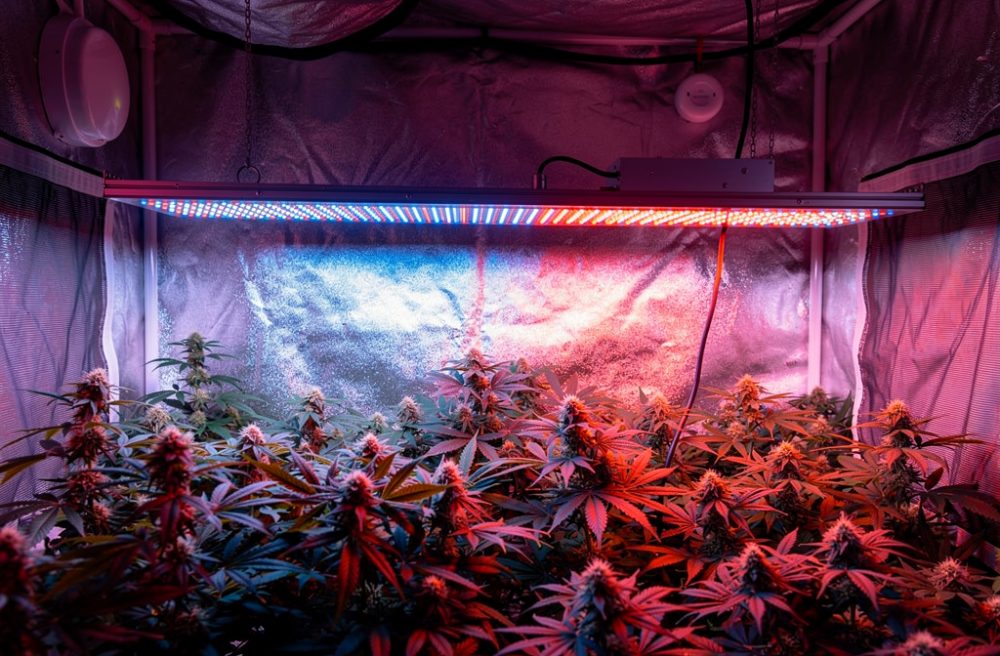
1,000 W LED Grow Light for Growth and Flowering: Complete Guide
This guide surveys full-spectrum 1,000 W LED grow lights on the market. It explains how to choose a high-performance 1,000 W LED grow light for growth and flowering, with the aim of increasing yields, reducing electricity costs and simplifying indoor growing cycles without changing your equipment.
Full spectrum in an LED grow light for growth and flowering
A full spectrum is the foundation of any premium LED grow light. A full-spectrum horticultural LED covers the 380–800 nm range, including blue light, which is essential for vegetative growth, and red light, which is important for flowering.
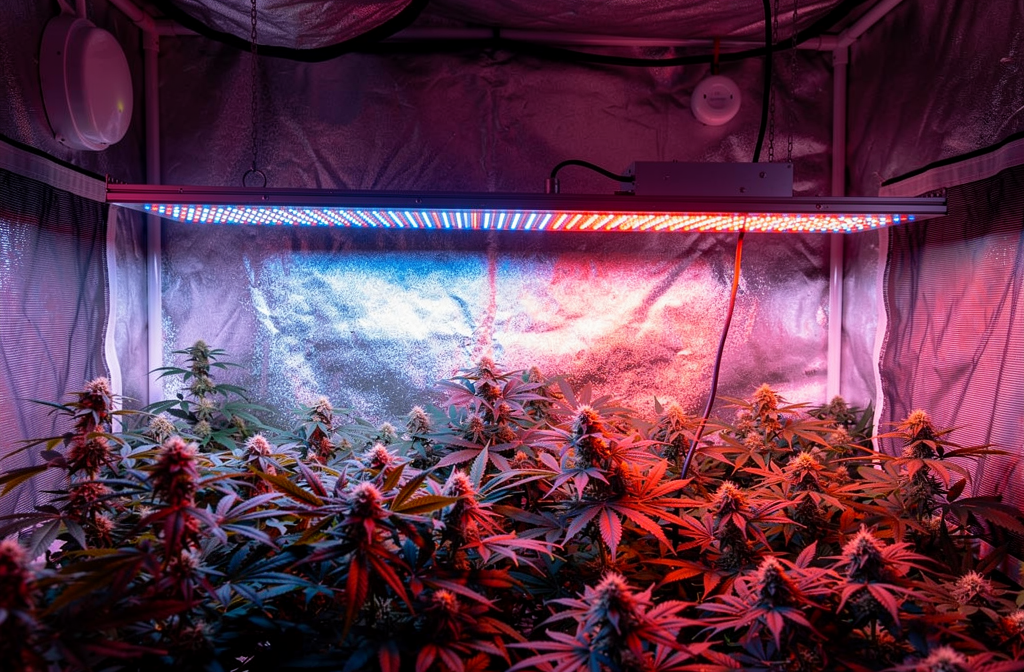
Why full spectrum matters for indoor growing
Choosing a full-spectrum 1,000 W LED grow light for growth and flowering means you do not need to buy several specialised fixtures. This all-in-one solution reduces clutter, simplifies installation and improves overallefficiency throughout your indoor growing setup.
- Optimal photosynthesis : A full spectrum for plants covers all useful light bands, efficiently converting light into cellular development at every stage.
- Natural colour perception : A colour rendering index (CRI) above 80 helps ensure plants appear in realistic colours, supporting pigment synthesis.
- Integrated far-red : Adding far-red light (730–760 nm) can produce larger buds and may increase final yield by 15–30%.
High-end CREE™ chips in these horticultural LED lights reproduce natural light. This supports photosynthesis from seedling to harvest without compromising the quality of growth and flowering.
Blue-to-red ratio by LED growth stage
By combining a full-spectrum LED with dimmable drivers, growers can adjust light distribution instantly. This lets them switch from an intense vegetative mode to a flowering mode without changing the grow-light.
- Vegetative phase (18 h/6 h cycle) : A blue-to-red ratio close to 1:1.5 supports dense foliage and a strong root system.
- Flowering phase (12 h/12 h cycle) : Shift the ratio to 1:3, favouring red photons to support reproduction and flower development.
- Gradual transition : Dimmable drivers allow gradual adjustments and help avoid physiological stress caused by abrupt changes.
- Verified spectrum certificates : At least 20% coverage in each key band ensures high efficiency throughout the indoor growing.
GreenVisuaLED solutions offer this precise electronic adjustment. A single LED grow light can then act like two separate fixtures, optimising both LED growth and flowering without additional expense.
CREE™ horticultural LEDs and far-red for flowering
CREE™ diodes represent one of the leading technologies used in horticultural LED lights. Their high efficiency converts more electrical energy into photons plants can use (measured in µmol), boosting both efficiency energy efficiency and performance during growth and flowering.
Strategically adding far-red to an LED grow light can significantly increase bud density and mass. Studies report yield gains of up to 30% when the full spectrum for plants is calibrated correctly during growth and flowering.
By mimicking natural summer sunlight, the full-spectrum LED developed by GreenVisuaLED brings out deeper greens and more vivid flower colours while maximising photosynthetic productivity (expressed in µmol/J). This realistic light provides efficiency for all your growing setups indoors.
Energy efficiency of a 1,000 W horticultural LED
efficiency sets modern grow lighting apart from conventional options, especially when choosing a horticultural LED light. Choosing a high-efficiency 1,000 W horticultural LED can significantly reduce operating costs while supporting stronger plant growth.
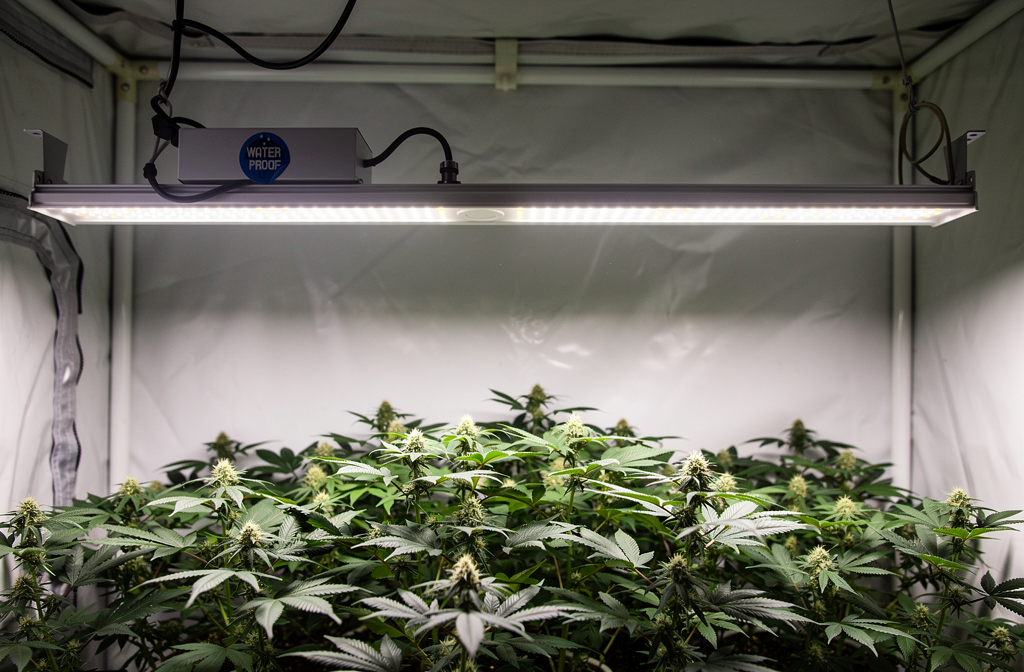
Actual consumption vs HPS equivalent for a grow light
It is essential to distinguish rated power from actual consumption when choosing the right grow light. A genuine high-efficiency 1,000 W horticultural LED uses only 110–150 W while converting 70–80% of that energy into usable photons.
For example, GreenVisuaLED states that a 200 W LED light can readily replace a 1,000 W HPS lamp, with an average efficacy of 2.5 µmol·J⁻¹, compared with only 1.2 µmol·J⁻¹ for sodium technology. Each joule consumed therefore generates nearly twice as much useful light, supporting photosynthesis and productivity.
| Light type | Actual consumption (W) | Efficacy (µmol·J⁻¹) | Service life (hours) | Estimated annual cost* |
| 1,000 W HPS | 1000 | 1,2 | 10 000 | €1,200 |
| 1,000 W equivalent LED | 250 | 2,5 | 50 000 | €300 |
| Savings with LED | -75 % | +108 % | +400 % | -75 % |
Over a twelve-week cycle, switching to a high-efficiency 1,000 W horticultural LED reduces total consumption from 300 kWh to about 150–180 kWh. This substantial reduction quickly improves the economics of growing under grow lighting.
LED horticultural lighting service life and return on investment
A high-efficiency horticultural LED can repay its initial cost thanks to an exceptional service life, often exceeding 50,000 hours of continuous use. At twelve hours per day, that is more than ten years of service, unlike the frequent replacements required by HPS lamps.
Light output loss is below 5% after 10,000 hours, providing stable illumination from one cycle to the next. Mean Well power supplies in particular provide reliable power, improving lasting performance and overall energy efficiency of the horticultural LED.
%products%
Coverage and placement of a 1,000 W grow light
Choosing the right distance and illuminated area is essential to optimise the efficiency of your indoor growing. The area covered by your 1,000 W LED grow light should be adjusted to whether plants are in the vegetative or flowering phase, as this directly affects photosynthesis and therefore final yields.
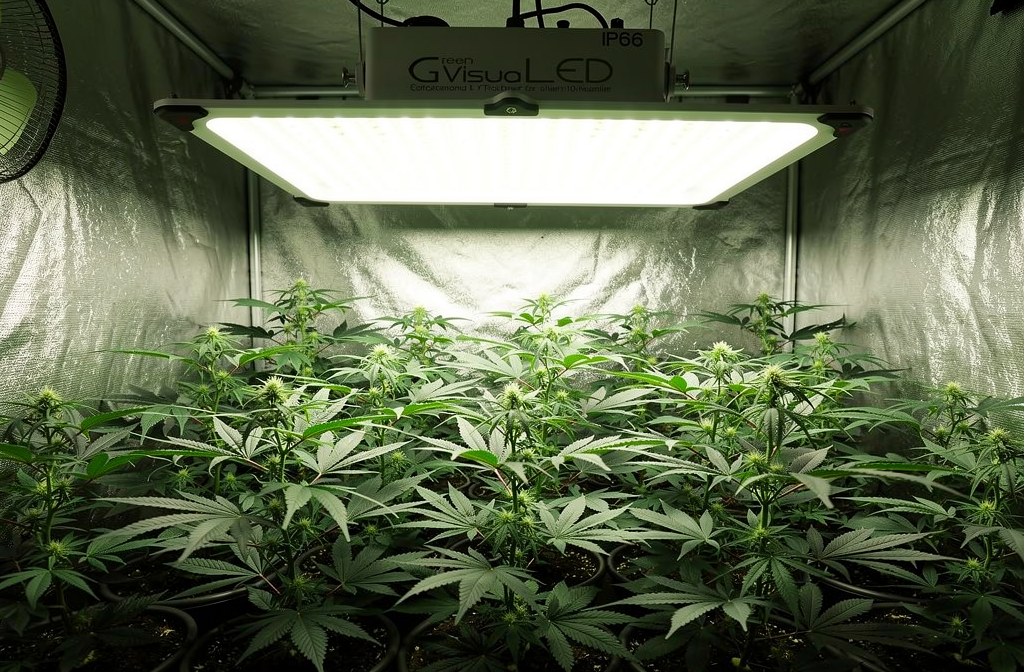
What area does a 1,000 W indoor LED grow light cover?
For flowering, the ideal 1,000 W LED grow light typically covers 1.5–2 m² (120 × 120 cm to 150 × 150 cm). During vegetative growth, the same lamp can evenly cover up to 2 m². Positioned 30 cm above the canopy, its high-density chips provide 750–900 µmol·m⁻²·s⁻¹, which suits most indoor crops during intensive flowering.
- Standard flowering : Over 1.5 m², photon flux is even and plant edges receive at least 600 µmol·m⁻²·s⁻¹ PPFD.
- Vegetative phase : The lamp covers up to 2 m², supporting a dense, balanced canopy without shaded areas.
- CO₂ enrichment: With CO₂, intensity can reach 1,500 µmol·m⁻²·s⁻¹, equivalent to full summer sunlight and reaching even the base of plants.
GreenVisuaLED modular systems minimise wasted energy. For example, six XModule V5 panels (900 W total) effectively light 2 m², while 120 cm bars can extend the area covered by an LED grow light to 3 m² at the same total power.
Height and PAR intensity by growing stage
The installation height of your indoor LED grow light directly affects PPFD, which decreases as the light source moves farther away. Adjusting height to the growth stage provides suitable light and protects foliage.
- Vegetative (45–60 cm) : This distance supports growth that is robust and dense, reduces the risk of light burn and stimulates foliage development.
- Flowering (30–35 cm) : Bringing the lamp closer concentrates light on the flowers and may increase photosynthetic photon flux density to 1,200 µmol·m⁻²·s⁻¹.
- Continuous adjustment: An adjustable suspension system can follow the canopy’s natural expansion throughout the growth.
- PAR meter monitoring: For efficiency the highest performance, aim for a PPFD of 600–900 µmol·m⁻²·s⁻¹ during growth and 900–1,200 µmol·m⁻²·s⁻¹ during flowering.
If you see bleached or curling leaves, this may indicate excess light. Gradually move the lamp farther away or reduce its intensity.
GreenVisuaLED modular systems for 1,000 W of lighting
The modular GreenVisuaLED system makes it easy to expand an indoor growingsetup without relying on inefficient excess power. Bars and LED grow lights can be connected in series or parallel to match the power precisely to the desired area.
The rails maintain ±10% uniformity across the canopy, and modules can be repositioned every 30 cm to suit any layout. Plug-and-play connectors simplify installation and avoid complex wiring, while X-WALL supports allow quick height adjustment.
Practical example: five 200 W bars combined with four 50 W spotlights total 1,200 W and can cover up to 4 m² flexibly. This scalable system lets you start small and gradually increase output to 1,000 W or more according to production needs.
Installing and managing heat from a 1,000 W horticultural LED
Careful temperature management is essential to maintain performance and extend the service life of a horticultural LED. For a successful 1,000 W installation, combine effective heat sinks with continuous ventilation to preserve overall system performance.
Heat dissipation and horticultural LED durability
A quality aluminium heat sink paired with a quiet fan keeps the module below 45°C, even during extended use. This thermal management keeps chip temperatures below 85°C and extends service life beyond 50,000 hours, potentially making it a sound investment over a period of up to ten years.
- Optimised heat sinks : Aluminium or copper designs remove heat quickly to protect the diodes and maintain consistent light output.
- Integrated ventilation : Quiet fans provide steady airflow, ideal for noise-sensitive spaces.
- Minimal degradation : After 10,000 hours, power loss remains below 5%, maintaining stable performance.
- Monthly maintenance : Regularly dusting the diffuser and protective panel helps prevent a 2–5% drop in output.
Thanks to its low heat output, an LED grow light can be positioned just 30–45 cm from the canopy, improving light penetration. By comparison, an HPS lamp needs a distance of 60–90 cm, which reduces intensity and photosynthetic efficiency.
Installation best practices and cycle settings
For best results, secure your 1,000 W horticultural LED firmly, provide adjustable height and use digital controllers to automate light cycles. Always pair thermal management with active ventilation to support CO 2 exchange and moisture removal.
- Cycle programming : Use an 18 h light / 6 h dark cycle for growth, then 12 h / 12 h for flowering, controlled automatically.
- Mylar reflectors : Mounted on the walls, they recover 10–15% of lost light and improve overall efficiency.
- Canopy ventilation : Gentle air movement stimulates evapotranspiration and reduces unwanted heat pockets.
A track or chain suspension system makes height adjustments easy without sacrificing stability. It helps avoid light burn and unwanted shadows while maintaining suitable light output throughout the growth phase.
Modularity and scalability of GreenVisuaLED solutions
The modular architecture of GreenVisuaLED solutions makes it easy to expand a 1,000 W horticultural LED setup. Bars connect without specialist tools, allowing you to increase power gradually to 1,000 W or beyond according to production needs.
This scalability suits many applications, including cannabis, hydroponic tomatoes, green walls and photography studios. Each can benefit from flexible horticultural LEDs designed for efficiency.
Frequently asked questions
Is a 1,000 W LED grow light really effective for flowering?
Absolutely. A LED grow light for growth and flowering marketed as a 1,000 W LED light can provide efficiency at the end of the cycle. In reality, this horticultural LED light uses just 110–150 W while emitting a flux of 2,500–3,200 µmol/s, about twice that of an equivalent HPS lamp. Its full spectrum, rich in red wavelengths and supplemented with far-red, provides an intensity of 750–900 µmol·m⁻²·s⁻¹ at a distance of 30 cm. This configuration supports growth and flowering strong growth and flowering, encourages dense buds and may provide a quick return on investment.
What is the LED equivalent of a standard 1,000 W HPS lamp?
In terms ofefficiencya LED grow light rated at 200–250 W is generally sufficient to replace a 1,000 W HPS lamp. This horticultural LED light produces about 2.5 µmol per joule (2.5 µmol·J⁻¹), compared with only 1.2 µmol·J⁻¹ for a sodium lamp. Therefore, a LED grow light for growth and flowering rated at 250 W produces a similar amount of useful light while saving nearly 75% energy. To cover the same area as a 1,000 W HPS, consider modular configurations such as three 300 W panels or six 150 W modules, potentially reducing the monthly bill by about 540 kWh.
How much area can a 1,000 W LED grow light cover without shadows?
A LED grow light for growth with a 1,000 W equivalent rating effectively covers about 1.5–2 m² during flowering and slightly more during vegetative growth. To achieve even lighting and eliminate shadows, using two LED grow lights for growth and flowering rated at 1,000 W, angled at 45°, is recommended to keep light variation below 10%. Depending on the setup, for example with six grow-light 150 W bars or modular panels, the area can be extended to 3 m². Position light sources 45–60 cm from the canopy during growth, then move them closer to 30–35 cm during flowering, while avoiding phototoxicity.
Related posts
 Discreet Green Wall Lighting: LED Design Guide
 Recessed Directional Grow Spot: A Guide for Plants and Green Walls
 Recessed LED Grow Bars for Green Walls: 2026 Comparison Guide