
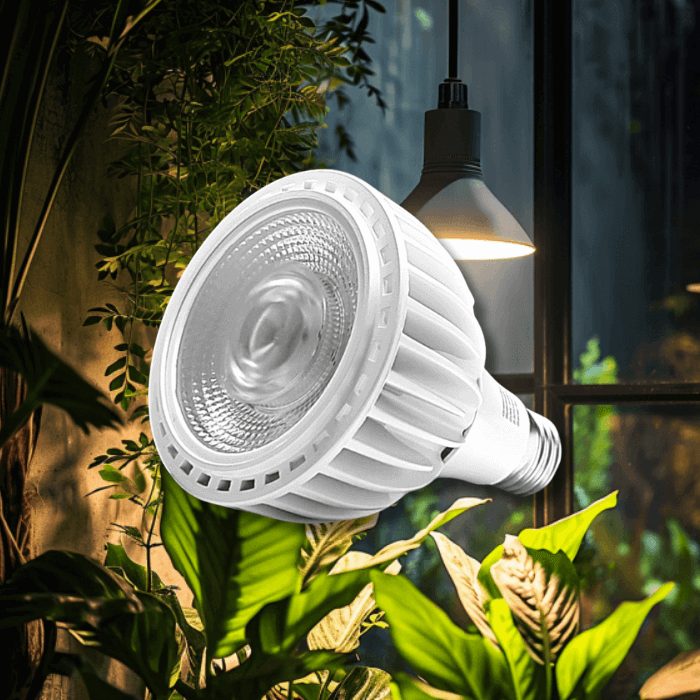
Plant light spectrum: a complete guide to optimising your growing setup
Choosing the right lighting for your houseplants means understanding how the light spectrum affects each stage of their development. This practical guide explains how full-spectrum horticultural LED lights can reproduce sunlight, support photosynthesis and promote balanced indoor growth—even when limited space or the season reduces access to natural light.
Understanding light and plants
Light powers photosynthesis, the process by which plants turn photon energy into sugars essential for survival. While the human eye measures brightness in lumens, plants absorb specific wavelengths between 400 and 700 nm, a range known as the PAR spectrum. Understanding this light spectrum helps you optimise horticultural lighting and provide the right light to support vigorous growth and abundant flowering in your houseplants.
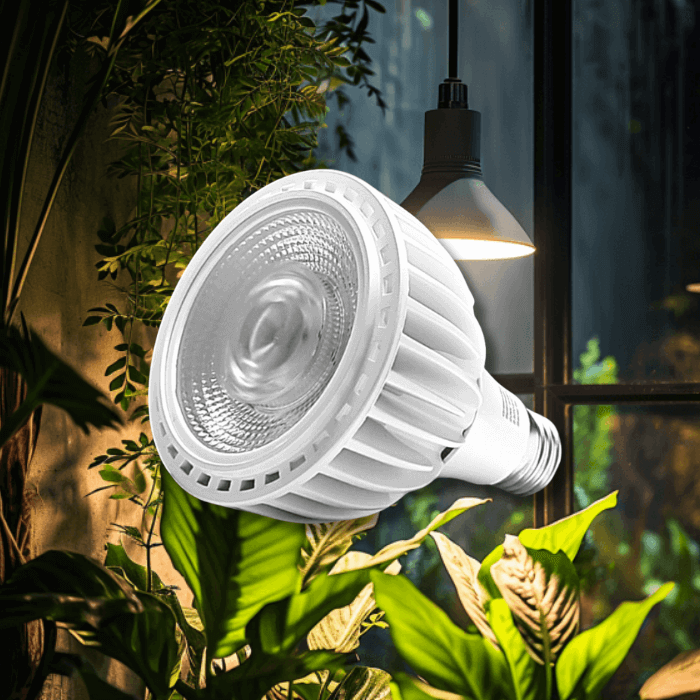
What are PAR and PPFD?
The light spectrum for houseplants is assessed in photons rather than lumens, because only PAR photons fuel photosynthesis. In indoor growing, we measure PPF, the total number of photons emitted each second, as well as PPFD, the photon density that actually reaches the foliage. PPFD and PPF readings show how efficiently a horticultural LED performs far more accurately than the wattage printed on its packaging.
- PAR spectrum (400–700 nm) : the full range of wavelengths efficiently absorbed by chlorophyll and other photosynthetic pigments.
- Total PPF : the overall quantity of useful photons produced by the lamp, regardless of the area illuminated.
- Measured PPFD : the photon flux reaching a specific area, which varies with output, distance and the presence of reflectors.
- Recommended quantum meter : an instrument such as the Apogee MQ-500 directly measures PAR, PPFD and PPF at canopy level to help you fine-tune your settings.
Our GreenVisuaLED horticultural lights combine blue, white and red diodes to reproduce a full spectrum close to sunlight. This full-spectrum LED provides an even energy distribution across the PAR range, helping to prevent leggy growth and yellowing leaves. Map PPFD at different heights, then adjust the position or number of panels to eliminate shadows and provide even horticultural lighting.
Our horticultural LED lighting solutions accurately reproduce the optimal light spectrum for your plants, delivering even PAR coverage, maximum photosynthetic efficiency and abundant flowering in any indoor space, from a framed plant display to a complete green wall.
Blue, red and green light and their effects
Blue light, between 400 and 500 nm, stimulates chlorophyll B, strengthens stems and promotes denser foliage. Red light, between 620 and 750 nm, activates phytochromes and triggers flowering, encouraging fruit and flower production. Green light penetrates deeper into the canopy, nourishing lower leaves and balancing the overall light spectrum.
For example, basil exposed to 30% blue, 30% white and 40% red light develops dense, especially aromatic foliage. By contrast, lighting that is too white and lacks blue-red components can cause plants to become leggy and their leaves to pale. A carefully balanced full spectrum therefore helps deliver the right effect at each stage of plant development.
UV and infrared: useful or risky?
UV-A can enhance plant colour and resilience, while carefully controlled UV-B can encourage the production of secondary metabolites. Far-red, a near-infrared range, affects stem elongation and can speed up the transition to flowering. However, excessive UV-B exposure burns plant tissue, so protect your eyes and limit exposure time.
As a general guideline, add five to ten minutes of UV-B per day during the final weeks of flowering to encourage terpene or cannabinoid production without stressing the plant. Our full-spectrum horticultural lights include controlled doses of these wavelengths, helping protect both plant and grower health while supporting indoor yields.
Which spectrum supports plant growth?
Adjusting the light spectrum to suit each stage of plant development is the key to successful indoor growing. Every phase—from germination through vegetative growth to flowering—needs precise proportions of blue, red and green light to support balanced growth, optimum vigour and generous yields, while reproducing the natural changes in sunlight over the seasons.
Adapting the spectrum to each growth stage
During germination and early sprouting, choose a cool spectrum rich in blue light —around 60% blue, 30% red and 10% green—to limit stretching and stimulate chlorophyll B production. Providing 20 to 24 hours of light helps avoid heat stress and encourages compact, vigorous seedlings ready for vegetative growth.
As the vegetative phase begins, gradually increase the proportion of red light: aim for a mix of 50% blue, 40% red and 10% green for 18 hours a day. This combination strengthens stems, thickens foliage and prepares the plant for vigorous flowering while respecting its natural cycle .
When the flowering or fruiting period begins, reverse the proportions with a spectrum of 70% red, 20% blue and 10% green under 12 hours of light. This setup encourages the formation of buds, flowers and fruit. For example, alternating 12 hours of soft blue light with 12 hours of intense red light for orchids can considerably increase the number of flowers produced.
- Germination : 60% blue, 30% red and 10% green to speed up emergence and limit seedling stretch.
- Vegetative growth : 50% blue, 40% red and 10% green to strengthen stems and thicken foliage.
- Flowering and fruiting : 70% red, 20% blue and 10% green, with a small amount of UV-B added at the end of the cycle to maximise production.
Make the transition between these stages gradually: reduce the proportion of blue while increasing red to avoid light shock. This approach closely reproduces seasonal changes in the natural light spectrum and optimises photosynthesis at every stage of development.
Lighting duration and intensity
The amount of light should be adjusted to the plant species and stage of development. Aim for a PPFD of 200–400 µmol·m⁻²·s⁻¹ for herbs and lettuce, 400–800 µmol·m⁻²·s⁻¹ during the vegetative phase for tomatoes or peppers, and 800–1,000 µmol·m⁻²·s⁻¹ during flowering. Full-spectrum plant lights with dimmable controllers make it easy to adjust the intensity without moving the light source.
Our horticultural LED GU10 bulbs, available in warm or neutral full-spectrum white and in 5W and 7W versions, simplify every stage—from sowing to flowering—for small indoor plants. Enjoy a quick, easy installation with full-spectrum light, adjustable intensity and no risk of overheating.
Choosing indoor lighting
To provide good lighting indoors, compare the available technologies, choose the right output and maintain the optimum distance between the LED light and the plant. Today, horticultural LEDs lead the way in horticultural lighting : they use little energy, last a long time and deliver a precise spectrum without producing excessive heat. Matching these settings to the needs of each species helps promote photosynthesis, flowering and healthy growth all year round, even when winter skies provide little sunlight.
LED output and optimum distance
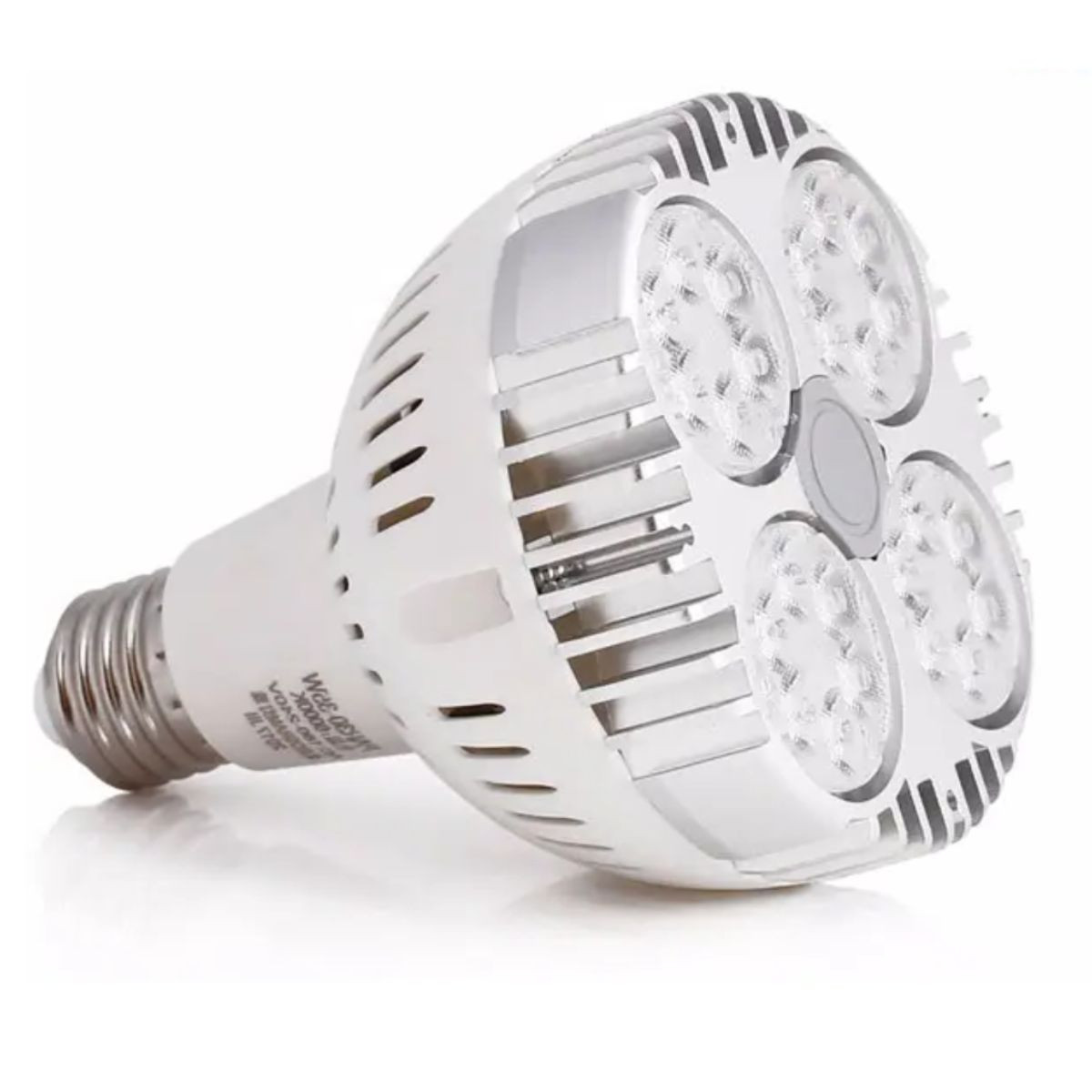
The horticultural LED outperforms CFL and HID technologies with excellent efficiency and precise control of the red and blue light spectrum to suit the plant. Position a 50W LED light 30 to 45 cm from the foliage: below 10 cm, the intensity may scorch leaves; beyond 60 cm, PPFD drops and photosynthesis slows. For miniature plants or bonsai, a 5–7W GU10 bulb at 10–30 cm is ideal, while a 20W E27 bulb at 20–60 cm can light several medium-sized plants.
Tomatoes and peppers generally need a 30W light with long-throw lenses, positioned 20 to 100 cm away depending on the desired intensity . Observe your plant : if the leaves turn pale or the stems stretch excessively, move the light closer; if you see signs of stress, move it away gradually. The red-and-blue plant light spectrum in our modules closely reproduces sunlight, stimulating vegetative growth and then flowering according to the programmed ratio.
Cycles, timers and even light distribution
A fixed light cycle controlled by a timer remains essential: provide 18 hours of light followed by 6 hours of darkness during vegetative growth, then switch to a 12/12 cycle for flowering. Complete darkness allows essential nighttime processes to take place. In winter, a 30W plant light for winter —a bar-style LED —used for 12 to 16 hours a day can compensate for low natural light and prevent plants becoming leggy.
To even out light intensity across all the foliage, install Mylar or Orca reflectors to bounce light back towards shaded areas. This allows five indoor ferns beneath a 30W bar set to 12 hours a day to thrive without overheating or excessive power use. XModule bars from 60 to 120 cm and SpectraLINE bars from 7 to 40W (IP65) cover large areas with a spectrum close to sunlight, ideal for green walls or hydroponic systems.
How the spectrum affects plants
The precise balance of red, blue and green wavelengths directly affects each plant's shape, vigour and productivity. By controlling these interactions, you can tailor lighting to encourage foliage development, speed up flowering or enhance aromas to suit your growing goals. This ability to customise the light spectrum is a key advantage of modern LED lights for houseplants.
Effective red, blue and green ratios
For balanced growth, a mix of 40% red, 40% blue and 20% green efficiently covers the PAR spectrum while maintaining a pleasant visual appearance. The GVL SPOT 30 horticultural LED light uses this full spectrum by combining a 660 nm red wavelength, a 450 nm blue wavelength and a green component that penetrates the canopy more easily. Although green light contributes less directly to photosynthesis, it still reaches deep into the foliage and does not interrupt the photoperiod when you check plants at night.
For basil, this balanced lighting produces dense foliage and stronger aromas thanks to the harmony between red and blue light. To thicken ferns or pothos, increase the blue proportion to 60%. Conversely, to encourage abundant flowering in tomatoes or orchids, choose a spectrum containing 70% red plus 3–5% far-red, which can slightly increase stem length towards the end of the cycle.
- Dense foliage (ferns, basil) : 50–60% blue, 30–35% red and 10–15% green to strengthen stems and leaves.
- Heavy flowering (orchids, tomatoes) : 60–70% red, 20–25% blue and 10–15% green, with an additional 3–5% far-red.
- Balanced growth (a range of green plants) : 40% red, 40% blue and 20% green for maximum versatility.
- Germination phase : 60% blue, 30% red and 10% green to limit stretching and speed up emergence.
Always observe how your plants respond: compact growth and deep-green colour indicate a good balance, while pale leaves or elongated internodes point to a need for greater light intensity or an adjusted spectrum. Programmable controllers make real-time adjustments easier.
Colour temperature and colour rendering
Measured in kelvins, colour temperature provides a quick guide: 6000–6500 K light, rich in blue, is particularly suitable for vegetative growth, while 3000–3500 K, with more red, is better for flowering. However, two lamps rated at 5000 K can produce different wavelengths depending on the LED technology used. For a planted aquarium, the answer to “which light spectrum is right for aquarium plants?” is a continuous spectrum from 400 to 700 nm that balances blue and red while avoiding excess UV that can encourage algae.
Our warm-white horticultural GU10 bulbs create a welcoming atmosphere while supporting photosynthesis in pothos and ferns. Neutral-white horticultural bulbs provide natural colour rendering, particularly appreciated for succulents and orchids with moderate light requirements. Alternating between warm and neutral white by season can also mimic changing sunlight.
Practical examples and product advice
For a cactus on a desk, a 5W warm-white GU10 bulb positioned directly overhead creates a focused pool of light without taking up space. No complex wiring is needed: simply screw in the bulb and adjust the intensity with your existing dimmer.
Position a neutral-white GU10 bulb 30 cm from your Phalaenopsis orchids. Its mix of blue and red light encourages flower buds while preserving the look of your living room.
The 30W GVL SPOT horticultural LED light provides a full spectrum across a 70 × 70 cm area at a height of 40 cm and is easy to mount on a wall or ceiling. It is plug-and-play and requires no complex installation.
During the vegetative phase, tomatoes covering 0.5 m² need around 21 W/m² and a PPFD intensity of 400–600 µmol·m⁻²·s⁻¹. Three 7W GU10 spotlights are also enough for a 50 cm ficus to maintain compact foliage. For larger areas, our XModule and SpectraLINE IP65 bars provide 7 to 40W of output, a spectrum close to sunlight, verified PPFD uniformity and over 50,000 hours of service life, backed by a three-year warranty.
Frequently asked questions
Which light spectrum is best for houseplants?
To grow a plant indoors, choose a full spectrum combining around 40% blue (400–500 nm), 40% red (620–750 nm) and 20% green (500–570 nm). Blue strengthens stems and stimulates vegetative growth, red encourages flowering, while green penetrates deep into the canopy, supporting even photosynthesis under a horticultural LED grow light.
Our LEDs from GreenVisuaLED faithfully reproduce this light spectrum, delivering effective horticultural lighting even in winter. Increase the blue intensity during vegetative growth, then favour red during flowering to adapt the light to your plants' changing needs indoors.
How do you measure the effectiveness of horticultural lighting?
The effectiveness of horticultural lighting is measured in PPFD (µmol·m⁻²·s⁻¹), which expresses the number of useful photons reaching the foliage of your plant. Lumens are designed for human vision and cannot measure photosynthesis; use a quantum meter such as the Apogee MQ-500 instead.
Aim for 200–400 µmol·m⁻²·s⁻¹ for herbs and 400–800 µmol·m⁻²·s⁻¹ for more demanding crops. Adjust the distance, output of your LEDs and the spacing between lamps to achieve even light intensity and avoid shadows or leaf scorch. A good full spectrum ensures optimum results.
What output and distance should I choose for a horticultural LED light?
Output depends on the size of the plant and the desired intensity : a 5W LED GU10 bulb is sufficient at 10–30 cm for a bonsai, while a 7W model can light plants correctly from over 30 cm away. For more demanding plants positioned 20 to 100 cm away, choose a 30W horticultural LED .
Keep the light more than 10 cm from the foliage to avoid scorching; PPFD becomes too high below this distance. However, do not exceed 60 cm if you want to maintain the right light spectrum and intensity for photosynthesis. GreenVisuaLED long-throw lenses distribute the full spectrum evenly and make it easier to light larger areas indoors, whatever the stage of plant development.
Related posts
 Discreet Green Wall Lighting: LED Design Guide
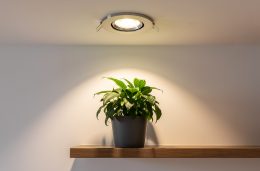 Recessed Directional Grow Spot: A Guide for Plants and Green Walls
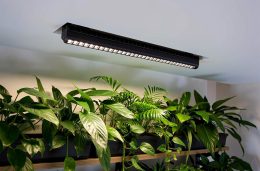 Recessed LED Grow Bars for Green Walls: 2026 Comparison Guide