
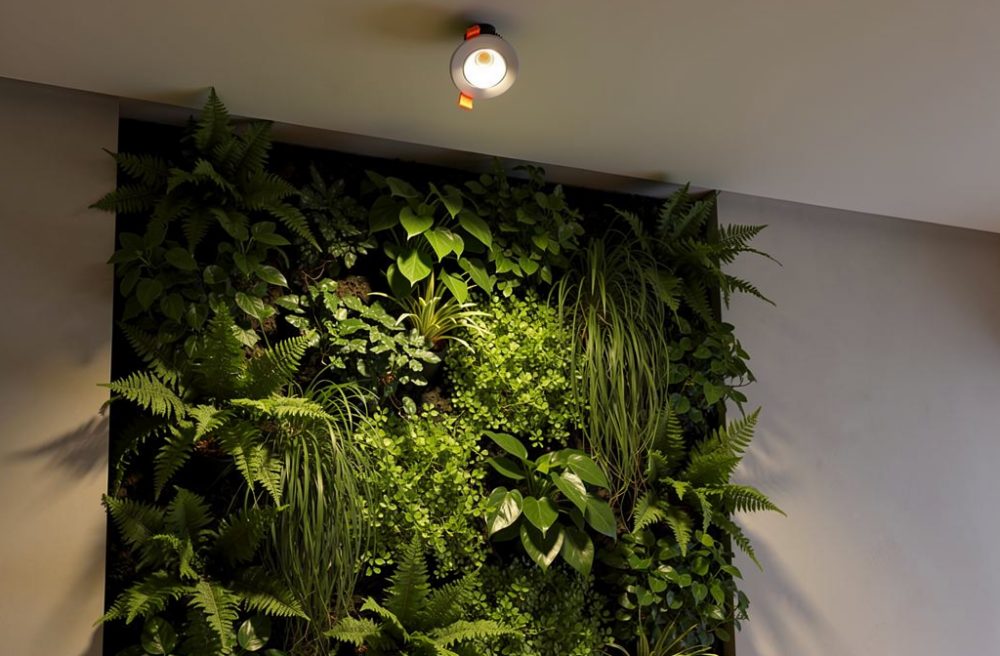
Recessed LED Spotlights for Green Walls: Complete Guide
This article offers helpful guidance for professionals and enthusiasts who want to light green walls effectively with recessed spotlights. It offers advice on determining the light output and positioning each fixture carefully. It also explains how to adjust the light spectrum to support healthy, balanced indoor growth.
What spotlight power should you choose for your green wall?
Choosing the right power is essential to the success of your project. The amount of light directly affects plants’ ability to photosynthesise and grow.
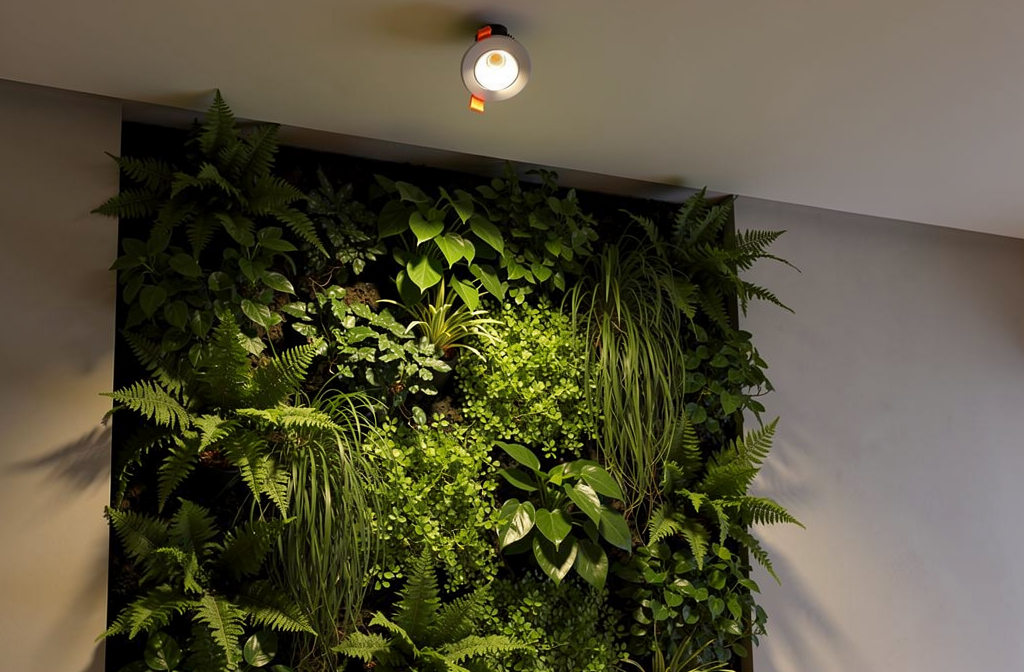
Calculating power according to planting area
The calculation is simple: multiply the total green wall area by 35 W/m² for typical plants. For example, a recessed LED spotlight rated at 35–40 W is generally suitable for one square metre planted with species that have average light requirements.
- Small decorative areas : A small recessed 9 W spotlight or a 12 W spotlight is well suited to lightly planted frames, mini-gardens or compact arrangements.
- Standard residential areas : For walls of 1–3 m², allow 35–40 W per unit, evenly spaced to avoid shadowed areas.
- Professional installations : For areas over 5 m², spotlights of at least 50 W or LED grow bars provide even light distribution.
- Plants with high light requirements : Heavy feeders such as tomatoes and fruiting plants need 40–50 W/m² to support abundant flowering and good yields.
For a wall 2 m wide and 1.5 m high (3 m²), allow about 105 W. Three recessed spotlights rated at 40 W each provide balanced light across the whole structure.
Optimal number and spacing of recessed spotlights
Correct spacing between spotlights is essential for even light distribution without shaded areas. Position each spotlight 30–45 cm from its neighbours for complete coverage while avoiding leaf scorch.
The inverse-square law states that doubling the distance between a lamp and a plant reduces light intensity by about 75%. This physical principle calls for careful planning, with enough fixtures to compensate for the natural loss.
| Wall dimensions | Total area | Number of spotlights | Power per spotlight | Total power | Plant type |
| 1m × 1m | 1 m² | 1 | 35-40 W | 35-40 W | Pothos, ferns |
| 2m × 1,5m | 3 m² | 3 | 40 W | 120 W | Philodendrons, foliage plants |
| 2m × 2m | 4 m² | 4-5 | 35-40 W | 140-200 W | Plants with average light requirements |
| 3m × 2m | 6 m² | 5-6 | 40-50 W | 200-300 W | Tomatoes, culinary herbs |
Light spectrum for indoor vertical plants
The quality of light plants receive is determined by its spectrum, which directly affects photosynthetic efficiency. At each growth stage, a precise distribution of wavelengths works together to support essential biological processes.
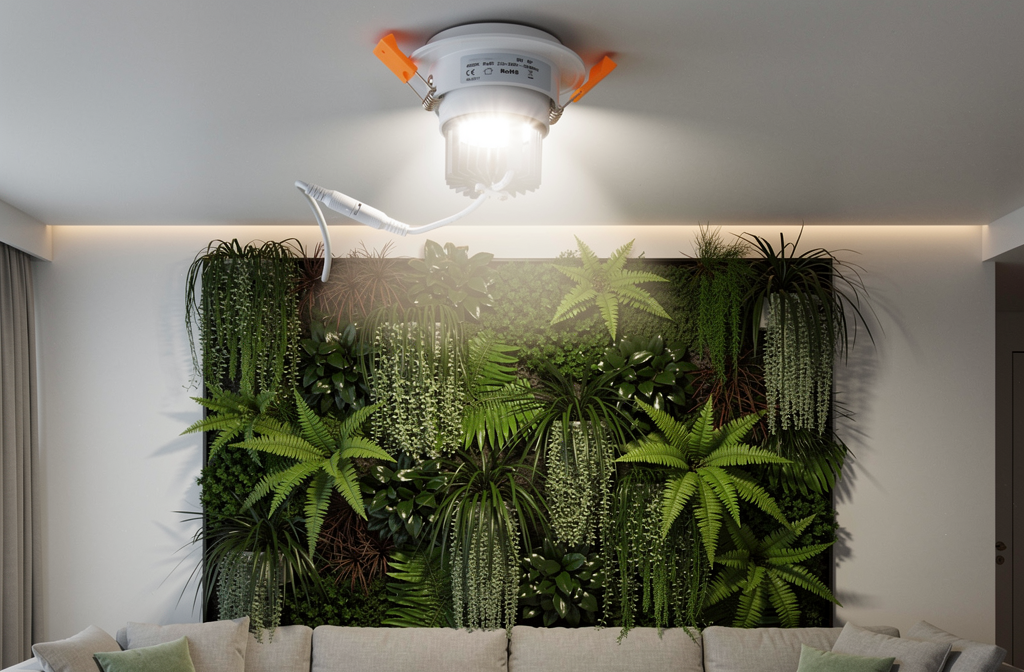
Essential wavelengths for plant growth
A balanced spectrum combines about 30% blue (440–450 nm), 50% red (around 660 nm) and 20% white light. This mix, suited to indoor green walls, stimulates chlorophyll synthesis, thickens foliage and supports the transition to reproduction.
- Blue light (400–500 nm) : It supports vegetative growth, strengthens leaves and helps prevent legginess; a blue-to-red ratio of 3:1 is suggested for early growth stages.
- Red light (600–700 nm) : It encourages flowering and fruiting. Gradually shifting to a 1:2 ratio during the reproductive phase can maximise flower production.
- Far-red light (700–800 nm) : It can promote stem elongation and fruit production, which may benefit culinary or productive species grown vertically.
Each spectral range activates specific photoreceptors, such as phytochromes and cryptochromes. These sensors in turn trigger biochemical responses that affect morphogenesis and regulate the transition to reproduction.
Adjusting the spectrum for each growing phase
Matching the light spectrum to plant growth rhythms optimises photosynthesis and supports the transition from vegetative to reproductive growth. Adjustable spotlights make this modulation easier and more precise.
During vegetative growth, maintain a blue-to-red ratio close to 3:1 to encourage compact foliage. As flowering approaches, gradually shift to a 1:2 ratio to direct more of the plant’s energy towards producing flowers and fruit.
Colour temperature and appearance for green walls
Colour temperature affects both the look of an interior and plant development. Around 4,000 K, light appears neutral and versatile; at 6,500 K, it resembles daylight and supports vigorous growth. Choose according to the aesthetic and horticultural goals of your installation.
A colour rendering index (CRI) above 80 preserves the natural foliage colours that make a green wall attractive. Accurate colour rendering also helps you spot signs of plant stress early, supporting the long-term appearance of green walls lit with properly calibrated white light.
%products%
Installing and positioning recessed LED spotlights
Recessed installation requires precision and care to ensure long-term reliability, excellent lighting performance and safety. This page presents our range of recessed horticultural LED spotlights, designed to fit discreetly into ceilings or partitions while offering flexible, elegant light direction.
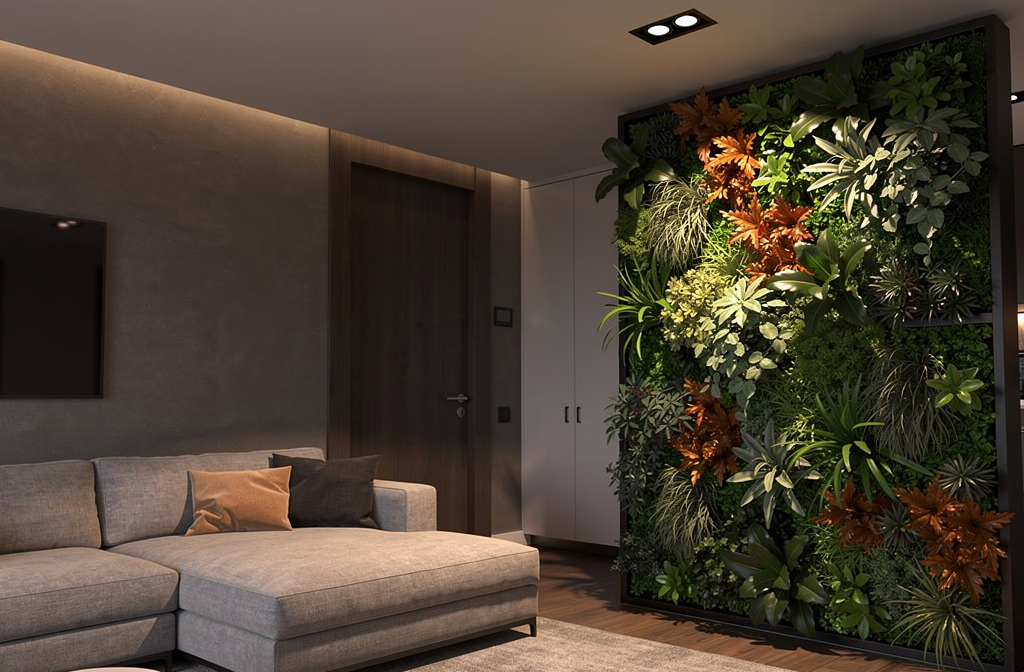
Recess depth and moisture protection
A recess depth of 60–65 mm allows the spotlight to fit properly, leaves room for connectors and supports internal ventilation. A horticultural silicone seal rated IP66 or IP67 isolates electrical components and protects them from ambient moisture and frequent splashes.
- Silicone waterproofing seal : Applied generously around the spotlight after recessing, it prevents water from the irrigation system from seeping in.
- IP67 rating : Provides full waterproofing, including temporary immersion, which is essential in humid environments (80–90% relative humidity).
- Reinforced recessed housing : Grooved anodised aluminium channels water outwards, while watertight connectors maintain electrical safety.
- Opal or diffusing lens : Resistant to condensation and easy to clean, this lens maintains light transmittance above 90%.
The article also discusses the difference between a green wall and a vegetated façade: a green wall uses a lightweight, self-supporting structure, a specific growing medium and integrated irrigation; indoors, it also requires dedicated grow lighting to support photosynthesis. Understanding these differences helps you choose the most suitable recessed installation.
Allow access for maintenance, particularly monthly lens cleaning: dust and moisture can reduce light output by 15–30%. This simple task preserves energy efficiency and extends the service life of recessed spotlights.
Optimal distance and angle for LED grow lighting
Optimal positioning distributes light evenly across each row and eliminates shadows that can hinder growth. Precise adjustment of distance and angle provides consistent light intensity across the wall.
- Vertical distance : Position spotlights 30–60 cm from the foliage during vegetative growth, then reduce the distance to 30–45 cm during flowering, provided the temperature stays below 25°C.
- Tilt angle : An angle of 30–45° towards the centre maximises light penetration between rows and limits shadows.
- 360° adjustable direction : The swivel mechanism lets you adjust the beam to suit foliage density and growth.
- Inverse-square law : Doubling the distance reduces light intensity by 75%; it is therefore better to install several nearby spotlights than a few fixtures set too far apart.
For a wall 2 metres wide, installing five or six 35 W spotlights, spaced 30–45 cm apart and angled 35° towards the centre, provides even coverage without overexposing the canopy.
Programming and maintaining your LED grow light
Each full-spectrum LED grow light combines blue, red and white light to support photosynthesis in foliage plants and green walls while limiting heat production.
A daily light cycle of 12–16 hours reflects seasonal variation and avoids excessive photoperiods. Program gradual 30-minute transitions at dawn and dusk to reduce physiological stress when phases change.
Clean the diffusers monthly with a damp microfibre cloth to maintain light transmittance above 90%. Check light distribution quarterly with a lux meter; any area measuring below 30,000 lux needs repositioning or additional recessed LED spotlights to maintain even grow lighting.
Frequently asked questions
What wattage LED spotlight should you choose for a green wall?
Choosing the wattage of a spotlight LED depends on several factors: the area to be lit, the varieties of indoor plants selected and the ambient natural light. For foliage plants and green walls as a general guide, allow 20–30 W/m² for low-light plants and 35–50 W/m² for those with higher requirements. For example, a 2 m by 1.5 m wall (3 m²) calls for about 105 W in total, equivalent to three 35 W spotlights. This provides lighting performance that is consistent and suitable.
How do you install a recessed light for vertical plants?
For an easy installationbegin by drilling a hole 90–95 mm in diameter and 60–65 mm deep in the support. Then recess the spotlight until it sits flush with the surface. Apply an IP66-rated silicone seal, then connect the cables using moisture-resistant connectors. After checking the seal, perform an electrical test with a dedicated circuit breaker. TL-GLV tracks and adjustable FloraCLIP E27 supports make it much easier to adapt the lighting to green walls and the growth of indoor plants.
Which light spectrum is suitable for indoor plants?
To support plant growth, an light spectrum effective spectrum should contain around 30% blue light (440–450 nm), 50% red light (660 nm) and 20% white light . This balance optimises photosynthesis . During vegetative growth, maintain a blue-to-red ratio of 3:1; shift to 1:2 when flowering. Also aim for a colour temperature between 4,000 and 6,500 K and a colour rendering index (CRI) above 80. spotlights that can be controlled allow precise adjustment, providing consistent lighting performance that is consistent and well suited to your foliage plants and green walls.
To size your setup, see our guide to green wall lighting.
Related posts
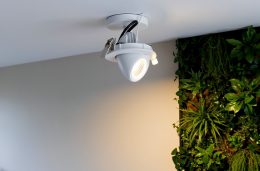 Discreet Green Wall Lighting: LED Design Guide
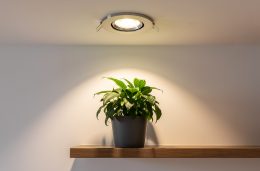 Recessed Directional Grow Spot: A Guide for Plants and Green Walls
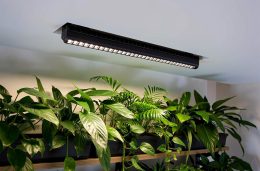 Recessed LED Grow Bars for Green Walls: 2026 Comparison Guide